Startup post-mortems repeat the same surface-level story: “We ran out of money.” But running out of money is never the cause — it’s the consequence. Money is only the final symptom of deeper failure patterns that start months or years earlier, long before the bank account hits zero.
Startups fail because they misread progress, misunderstand their job performers, optimise for the wrong signals, or build solutions in search of demand that isn’t there. They fail because the assumptions baked into their business model innovation, customer insights, pricing strategy, and acquisition logic remain untested.
In other words:
Startups die from misalignment, not from empty accounts.
This lens matters not only for founders. It matters for corporate innovation teams, incubators, and venture builders who repeat the same mistakes inside large organisations. The pattern is universal.
The danger increases when a venture begins behaving like a company before market evidence has justified it. Budgets, roadmaps, hiring, and internal alignment can make the initiative appear more mature while the underlying assumptions remain weak.
The same failure can begin even earlier: organizational incentives and governance can kill corporate innovation before the market has a chance to judge it.
The Myth: Startups Fail Because of Capital
Capital doesn’t save weak demand, wrong jobs, or flawed business models.
If a startup has:
weak insight
unclear job performers
no evidence of customer demand
wrong pricing logic
a solution that doesn’t replace existing habits
…then raising more money just buys a longer runway to fail.
Startups don’t run out of cash.
They run out of reasons for customers to care.
The Real Root Causes of Startup Failure
1. Misunderstanding the Job Performer
Most startups assume the user, buyer, and beneficiary are the same person.
They rarely are.
A product can fail because:
it solves a user problem but not a payer problem
it creates value for one role but friction for another
it assumes adoption from the wrong decision-maker
JTBD reveals these mismatches early.
Stuck with this topic and need hands-on help?

2. Building the Solution Too Early
Many founders fall in love with the product before they understand the job.
They:
start with “what we can build”
validate with friendly users
confuse enthusiasm with demand
skip switching forces
mistake prototypes for evidence
The core question is never can we build it.
It’s why should this exist?
And who will replace their current behavior with it?
3. Serving Multiple Jobs at Once
The fastest way to fail is to try serving too many jobs, too many segments, or too many performers simultaneously.
An early-stage startup can only serve one job performer with one job until there is evidence to expand.
Trying to do more leads to:
diluted messaging
incoherent value propositions
product bloat
conflicting priorities
no clear adoption path
4. Wrong Pricing Logic
Startups often price based on:
competitor benchmarks
production cost
founder intuition
But customers don’t pay based on any of that.
They pay based on:
perceived progress
switching friction
emotional risk
status implications
trust in the alternative
Without understanding these dynamics, pricing becomes a guess — and guesses rarely survive the market.
5. No True Demand Validation
Startups often collect the wrong signal:
clicks
survey answers
“looks cool” feedback
early pilot success that does not translate to scale
They mistake interest for intent, and intent for commitment.
Real demand shows up when:
a customer switches
a customer pays
an existing behavior is abandoned
risk shifts from startup → customer
Until that happens, nothing is validated.
6. Business Model Misalignment
This is the silent killer.
Startups fail when:
cost structure cannot support the price
customer acquisition cost exceeds lifetime value
distribution logic is incompatible with user behavior
the business model doesn’t match the job
Most founders discover this too late — after scaling the wrong model.
These failures rarely occur in isolation because business model validation must test the whole system. Customer desirability cannot compensate for incompatible distribution, delivery, pricing, or cost assumptions.
Why Ecosystem Dynamics Matter More Than Product Strategy
Many startups see themselves as independent actors.
In reality, they exist inside networks of dependencies:
buyers influence users
users influence payers
gatekeepers block adoption
workflow constraints shape behavior
ecosystem partners shape switching forces
Failing to understand the ecosystem is failing to understand the job.
This applies equally to innovation inside large organizations, where political dynamics and legacy systems become additional gatekeepers.
The Pattern Behind All Startup Failures
Every major failure falls into one or more of these categories:
Wrong problem
Wrong job performer
Wrong job
Wrong demand signal
Wrong business model
Wrong metrics
Wrong ecosystem assumptions
Everything else — timing, competition, cash — is merely the visible surface of deeper misalignment.
The Good News: Most Startup Failure Is Preventable
Startups don’t need perfect ideas.
They need:
insight
clarity
evidence
disciplined testing
alignment between the job, the solution, and the model
Startups that learn faster than they burn succeed.
Startups that burn faster than they learn collapse.
Success is not a function of creativity.
It’s a function of discovering, validating, and serving real progress.
A practical example of this problem is why Starbucks struggled in Switzerland after misreading local progress and context. Market size and brand strength did not eliminate the need to understand why customers would change established behavior.
Free Ad-on: The Hidden Layer and its Root Causes
When I ran each symptom through the 5 Whys and fishbone (Ishikawa), a deeper layer emerged.
Each reason connects back to patterns of behavior, bias, or system design.
Here’s what that looks like:
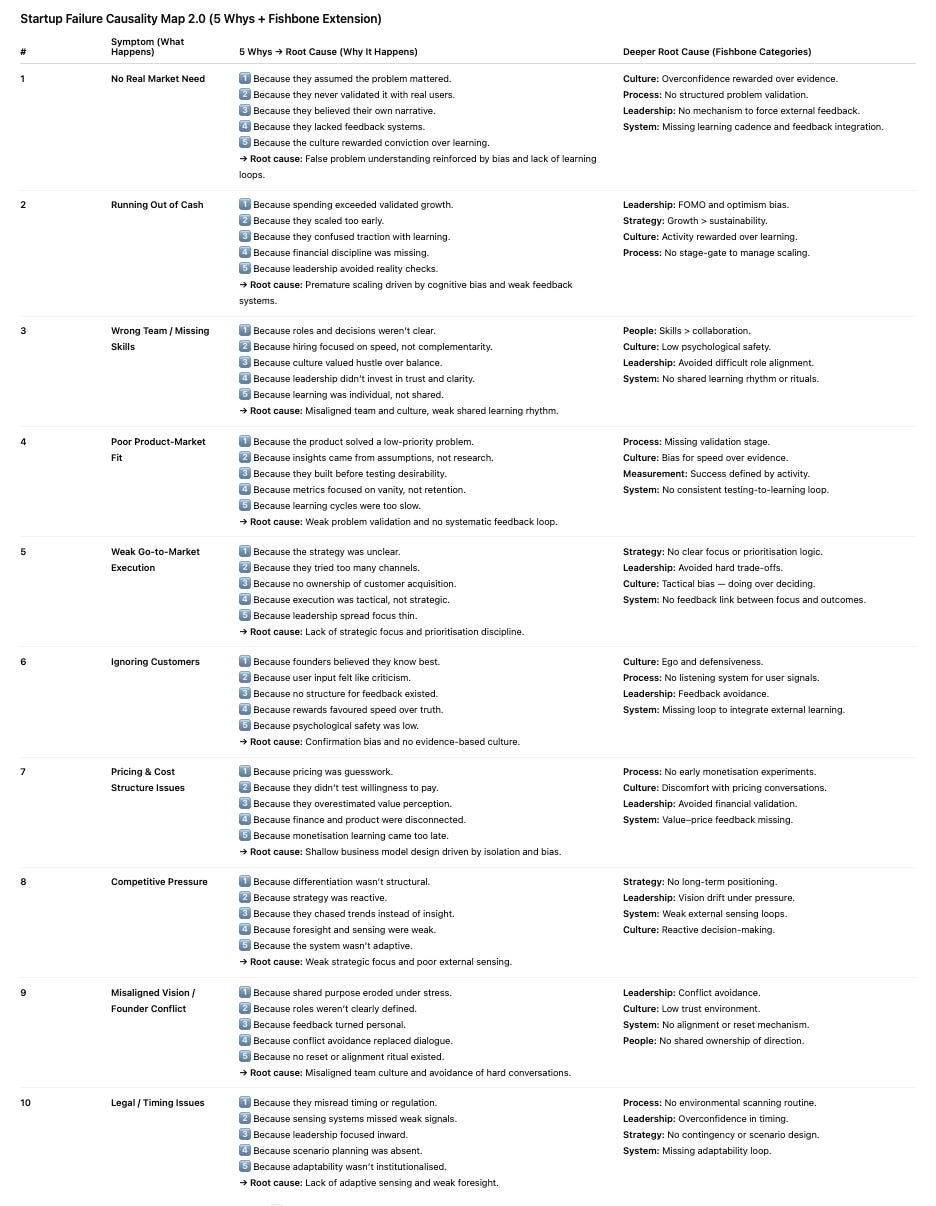
When I mapped these connections visually, a pattern appeared — a structure that revealed how each surface-level failure grows out of deeper system weaknesses.