


Adobe is usually presented as one big transformation: from selling perpetual software licenses to offering Creative Cloud subscriptions.
That interpretation begins too late.
Adobe did not replace one business model once. It repeatedly changed whichever element was limiting its ability to create, deliver or capture more value.
PostScript established an OEM-licensed printing standard. PDF extended Adobe into universal document exchange. Creative Suite integrated previously separate tools. Omniture added analytics and marketing. Creative Cloud created a recurring relationship. Behance added a creator community. Document Cloud expanded PDF into workflows. Magento connected content with commerce. Express opened creation to non-professionals. Firefly and GenStudio are now moving Adobe towards AI-enabled enterprise content production.
Each adaptation strengthened Adobe’s position in the customer workflow. Each also increased the customer’s dependence on Adobe.
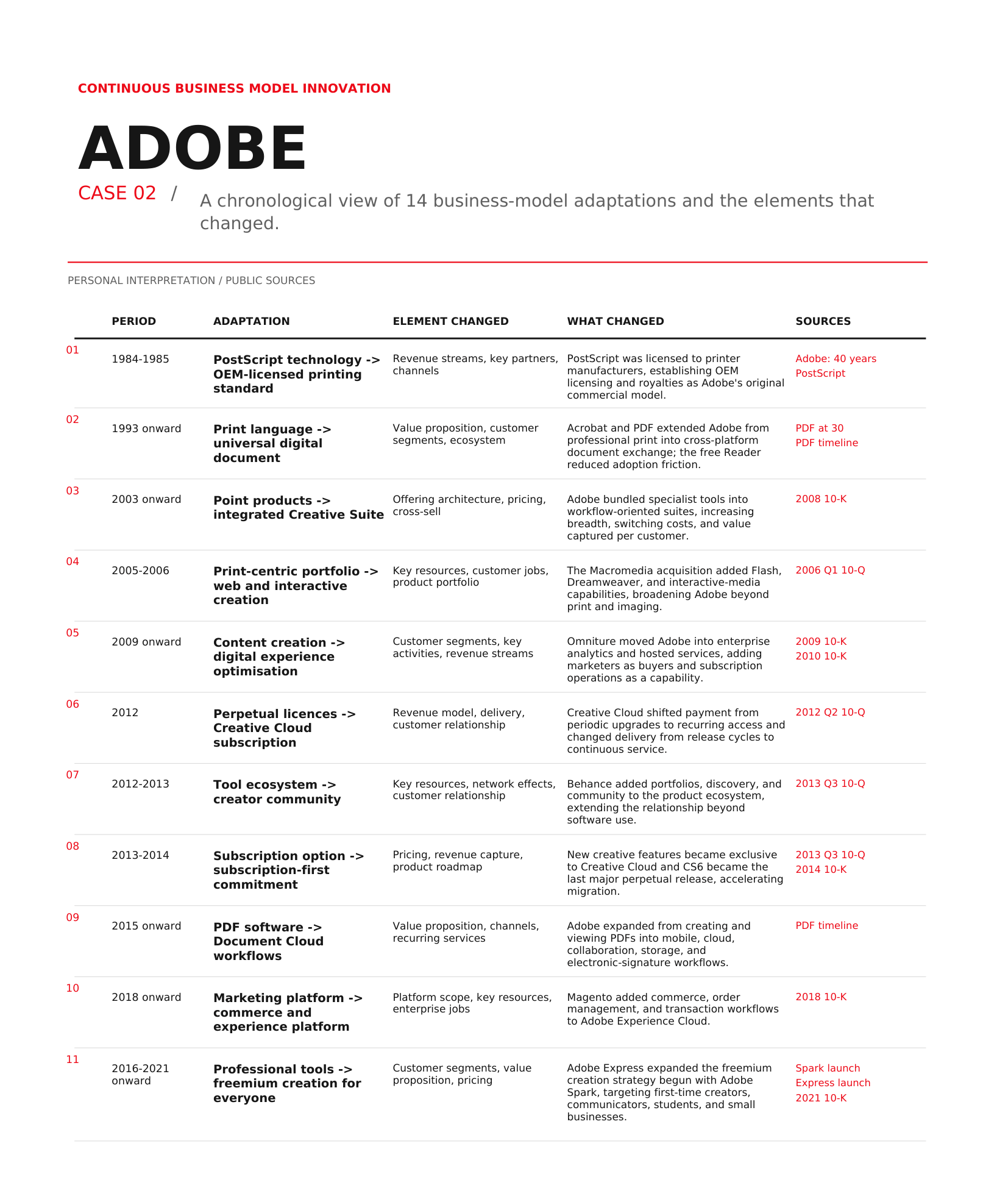
The familiar story begins too late
The familiar Adobe story starts with Creative Cloud. In 2012, the company began moving customers from perpetual licenses and periodic upgrades towards recurring subscriptions and continuous software delivery.
It was a consequential and controversial decision. But it was already Adobe’s sixth major business-model adaptation in this chronology.
Adobe’s original commercial model was built around licensing PostScript to printer manufacturers. Acrobat and PDF then expanded the value proposition from reliable printed output to exchanging digital documents across different systems. The free Reader reduced adoption friction and helped PDF become more valuable to those paying to create and manage documents.
Creative Suite integrated specialist applications into a broader workflow. Macromedia expanded that workflow into web and interactive creation. Omniture moved Adobe beyond producing content and towards measuring and optimising what that content achieved.
Creative Cloud did not begin Adobe’s transformation. It changed the constraint again.
Periodic product releases and upgrade decisions were replaced by continuous delivery and recurring access. Revenue became more predictable, but Adobe also became responsible for maintaining an ongoing service and continually demonstrating value.
The move changed far more than the price.
Four phases of adaptation
1. Establish standards and reduce adoption friction
PostScript created value by connecting computers, software, fonts and printers. Adobe did not need to manufacture the entire system. It occupied an important position between its components and captured value through OEM licensing and royalties.
PDF expanded that position. Instead of focusing only on producing printed output, Adobe enabled documents to retain their appearance across systems.
The free Reader was central to the model. It reduced the friction of receiving and viewing a PDF, making the format more useful to those paying for document creation and professional capabilities.
Free access on one side supported paid value on the other.
2. Integrate and broaden the creative workflow
Creative Suite combined specialist applications into a broader offering. This increased the amount of the creative workflow Adobe could support and the value it could capture from each customer.
The Macromedia acquisition added Flash, Dreamweaver and other interactive-media capabilities. Adobe was no longer concentrated primarily on print, imaging and documents. It expanded with the changing forms of digital content.
Integration improved the customer workflow because tools could be used together. It also increased switching costs because the customer relationship no longer depended on one replaceable application.
Adobe was becoming more valuable partly because more of the customer’s work happened inside its ecosystem.
3. Turn products into recurring relationships and workflows
Omniture moved Adobe into analytics, marketing and hosted services. This introduced new buyers, including marketing departments and large enterprises, and required capabilities in data, cloud operations and enterprise sales.
Creative Cloud then changed payment, delivery and the customer relationship. Instead of selling a major release and later convincing customers to upgrade, Adobe could deliver improvements continuously and maintain a direct recurring relationship.
Behance extended that relationship beyond the use of software by adding portfolios, professional discovery and community. Document Cloud expanded PDF from a file format and desktop product into mobile access, storage, collaboration and electronic-signature workflows.
Adobe Spark, later relaunched as Adobe Express, created a freemium entry point for first-time creators, communicators, students and small businesses. Magento extended Adobe’s enterprise portfolio into commerce and transaction workflows.
These were different moves, but they followed the same direction: Adobe kept expanding from the individual tool into the surrounding work.
4. Move from proprietary tools towards governed AI workflows
Firefly embedded generative AI inside the applications Adobe customers were already using. Generative credits also introduced metered usage within subscription plans.
This was a business-model response as much as a product response. Generative AI creates variable computing costs that a conventional software subscription does not automatically accommodate. Credits allowed Adobe to connect usage with commercial limits without abandoning the subscription relationship.
GenStudio extended the proposition further into the enterprise content supply chain: planning, creation, brand governance, activation and measurement.
Adobe then began adding partner models from companies including OpenAI and Google to Firefly. This changed the platform logic again. Adobe no longer had to depend entirely on its proprietary models being superior for every task. It could compete as the trusted workflow and governance layer through which customers access different AI capabilities.
The individual model may become interchangeable. The surrounding workflow is harder to replace.
Three lessons from the case
1. Business-model innovation can be cumulative
Not every Adobe adaptation replaced the previous model. Many changed only one or two elements while preserving capabilities, customer relationships, standards or assets created earlier.
PostScript established Adobe inside the publishing ecosystem. PDF expanded the job. Creative Suite increased the share of the workflow. Creative Cloud changed delivery and revenue capture. Later moves added community, analytics, commerce, collaboration and AI.
Continuous business-model innovation is therefore not necessarily a sequence of dramatic pivots. It can be the repeated reconfiguration of selected elements before the existing configuration becomes a constraint.
Netflix’s business-model evolution provides a useful comparison. Both companies repeatedly changed parts of their models, but the constraints differed: Adobe expanded its role in customer workflows, while Netflix adapted distribution, content ownership and revenue capture.
2. A new revenue model requires a different operating model
Creative Cloud is often reduced to subscription pricing. But recurring billing alone would not have created recurring value.
The change also required continuous product delivery, cloud infrastructure, account management, direct customer relationships and a different development rhythm. Omniture, Document Cloud, Magento, Firefly and GenStudio required additional capabilities in analytics, enterprise sales, commerce, AI computing, governance and workflow orchestration.
Changing how a company captures value without changing how it creates and delivers that value produces a commercial mechanism, not a coherent business model.
This is why business model validation must test the whole system, including the connections between customer value, delivery, capabilities, revenue and economics.
3. Customer value and customer dependence can grow together
Adobe’s integrations can make work easier. Files move between applications, teams share assets, organisations manage permissions, and enterprises connect creation with approval, activation and measurement.
The same integrations make Adobe more difficult to leave.
Files, skills, subscriptions, workflows, shared assets, communities, governance rules and enterprise systems accumulate around the ecosystem. Exiting may require more than replacing a product. It may require changing how work is organised.
This creates the strategic tension at the centre of the case:
Each move expanded customer value and revenue predictability, but also increased customer dependence on Adobe. The model became stronger partly by making exit, substitution and ownership less simple.
The relevant distinction is not simply between integration and lock-in. It is between retention created by value customers repeatedly choose and retention created by the cost of leaving.
Both may produce similar commercial results. They indicate different qualities of business-model strength.
Future cases will examine other organizations that changed their business models as technologies, customer behavior and old assumptions became constraints. Subscribe for source-backed cases, strategic interpretation and practical decision tools.
What would you challenge?
Which Adobe adaptation most fundamentally changed the company’s business model?
I am particularly interested in interpretations that challenge the chronology, the business-model elements I assigned or the tension between increasing customer value and increasing customer dependence.
Use this case with your team
I am developing Continuous Business Model Innovation as a format for executive briefings, strategy off-sites, workshops, bootcamps and teaching.
The purpose is not to copy Adobe or introduce a subscription because it worked for someone else. It is to help a team determine which part of its own business model has become a constraint, which assumptions require evidence and what should be tested before committing further resources.
If your organization is facing such a decision, my innovation strategy consulting provides independent challenge and structured decision support before further resources are committed.
This analysis reflects my personal interpretation of Adobe’s business-model adaptations based on available public data and public sources. Adobe and related marks are trademarks of Adobe Inc. This independent analysis is not affiliated with or endorsed by Adobe.
Subscribe to INNOVATION&
Evidence-based analysis, practical tools and innovation strategy consulting for leaders deciding what to test, fund, pivot, stop or scale.