


Netflix is usually presented as one big pivot: from DVDs to streaming.
That interpretation is too neat.
Netflix did not replace one business model once. It repeatedly changed whichever element was becoming the constraint on its next stage of growth.
Subscription removed transaction friction. Streaming removed physical distribution. Device partnerships expanded access. Originals reduced dependence on licensed content. Global expansion increased reach. Advertising, paid sharing, games and live programming created new forms of engagement and revenue.
Netflix’s business-model innovation extended well beyond the move from DVD rental to streaming. Subscriptions changed how customers paid, streaming changed distribution, and original programming changed Netflix’s dependence on content suppliers. Later adaptations changed its market reach, engagement and sources of revenue.
Treating this history as one successful pivot hides the more useful pattern: Netflix repeatedly changed parts of its business model as constraints emerged, sometimes reversing course when a decision failed. Each adaptation addressed a problem while introducing new commitments and risks.
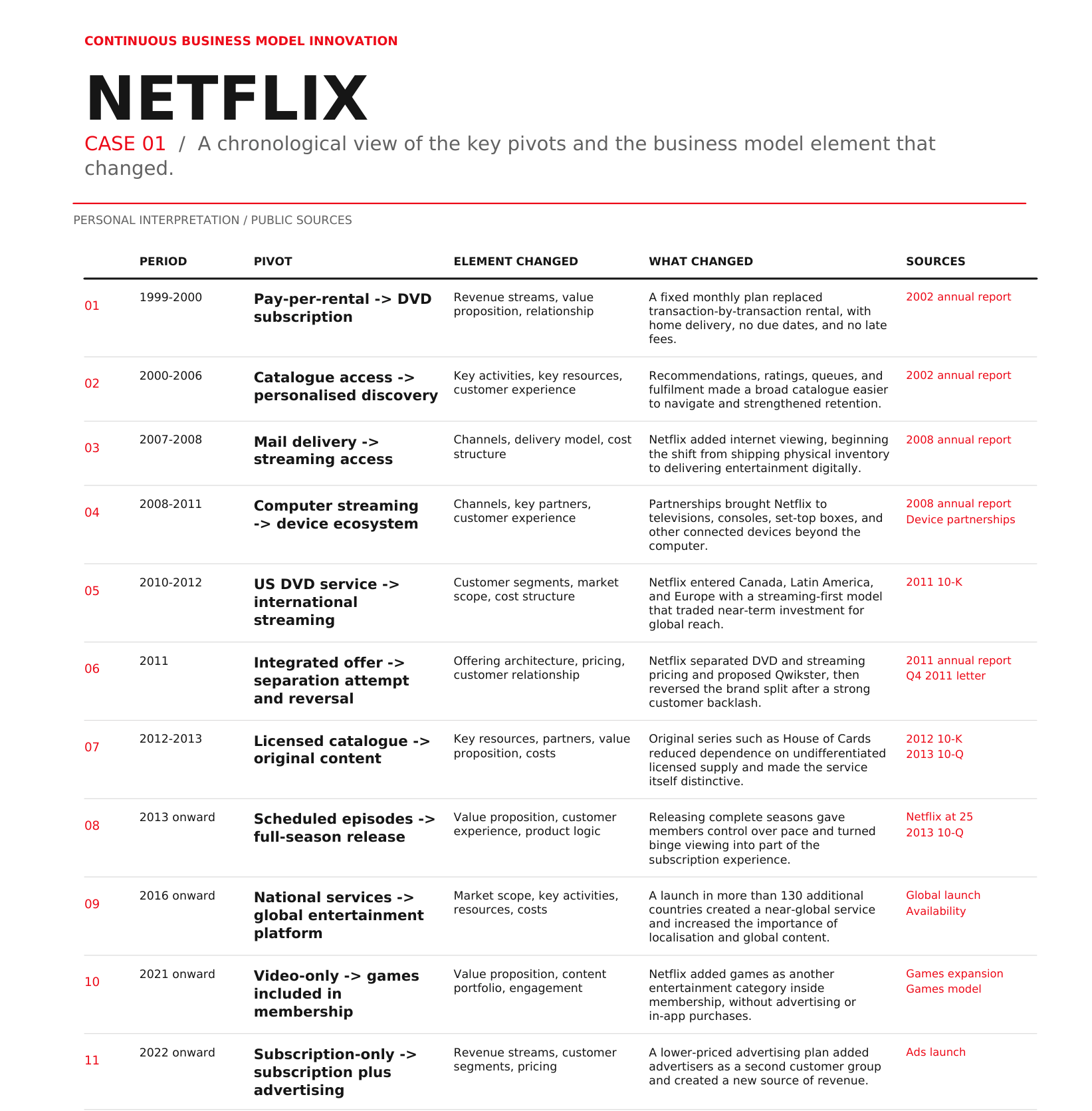
The familiar story hides the more useful pattern
The familiar Netflix story moves cleanly from DVD rental to streaming. It is attractive because it compresses a complicated history into one decisive strategic move.
But the transition to streaming did not complete the transformation. It changed the constraint.
Physical distribution became less important, but access to licensed content became more important. Original programming reduced part of that dependence, but required larger and less reversible content commitments. Global expansion increased the potential market while introducing localisation, regulation and content-production complexity.
More recently, slowing subscriber growth moved the constraint again. Netflix responded with an advertising tier, tighter household access, games and live programming. The problem was no longer simply how to reach more viewers. It was also how to capture more value and increase engagement from the audience already within reach.
Four phases of adaptation
1. Remove transaction and distribution friction
The original subscription model replaced individual rental decisions, due dates and late fees with recurring access. Streaming then removed the delay and cost of physical fulfilment, while device partnerships made the service available beyond the computer.
2. Reduce dependence and differentiate the offer
Streaming gave Netflix a new channel, but much of the value still depended on content owned by others. Original programming made the service more distinctive and gave Netflix greater control over availability, timing and global distribution.
3. Expand the addressable market
International expansion turned Netflix from a US service into a global platform. This increased potential scale but required local content, language capabilities, market knowledge and a much more complex production system.
4. Expand engagement and revenue capture
Games broadened the entertainment proposition. Advertising introduced advertisers as a second customer group. Paid-sharing rules converted part of informal access into revenue. Live programming added urgency, appointment viewing and additional advertising inventory.
Three lessons from the case
1. Continuous adaptation includes reversals
Qwikster belongs in the chronology because business-model adaptation is not a clean sequence of correct decisions. Netflix separated DVD and streaming pricing, proposed a separate service and then reversed the brand split after encountering strong contrary evidence.
The reversal was not separate from the adaptation process. It was part of it.
2. Removing one constraint creates another
Streaming reduced fulfillment friction but increased dependence on licensed content. Originals created differentiation but increased fixed commitments. Global scale increased reach but also increased localization complexity.
Business-model adaptation rarely eliminates uncertainty. It relocates it.
3. The object of adaptation changes over time
Netflix initially changed how customers accessed and paid for entertainment. Later changes increasingly concerned content ownership, market scope, engagement and revenue capture.
The relevant question was not simply whether the existing model still worked. It was whether it could support the company’s next stage of growth.
Continue with Adobe’s business-model innovation: fourteen strategic shifts, which examines how the company expanded from individual tools into customer workflows—and how greater customer value can also create greater dependence. Subscribe for source-backed cases, strategic interpretation and practical decision tools.
What would you challenge?
Which Netflix adaptation created the most consequential new constraint?
I am particularly interested in interpretations that challenge the chronology, the business-model elements I assigned or the core pattern I identified.
Use this case with your team
I am developing Continuous Business Model Innovation as a format for executive briefings, strategy off-sites, workshops, bootcamps and teaching.
The purpose is not to copy Netflix. It is to help a team determine which part of its own business model has become a constraint, which assumptions require evidence and what should be tested before committing further resources.
If your organization is facing such a decision, send me the concrete situation you are working through.
This visual reflects my personal interpretation of Netflix’s business-model adaptations based on available public data and public sources. Netflix and related marks are trademarks of Netflix, Inc. This independent analysis is not affiliated with or endorsed by Netflix.