
Something has been bothering me for a while, and a presentation I sat through recently brought it into focus.
The topic was AI-powered innovation workflows: agentic tools, automated pipelines, synthetic personas, AI-generated user research. The pitch was familiar. Move faster, reduce cost, generate more concepts, test more variants, validate earlier. The automation was real. The speed gains were real. About halfway through, I noticed something missing.
There were no actual users in the process. Somewhere along the way, the conversation with a real person had been replaced by a synthetic abstraction of one. AI personas built from demographic assumptions. Behavioral models constructed from historical patterns. Simulated responses from people who do not exist.
I understand the appeal. Real users are hard to reach, slow to schedule, and inconsistent in ways that make analysis uncomfortable. Synthetic stand-ins are faster, cheaper, and available at two in the morning. The research on this is also real: a 2024 Stanford and Google DeepMind study found that AI agents built from two-hour interviews with 1,052 people replicated their subjects’ social survey responses with 85 percent accuracy. That is genuinely useful at the hypothesis-generation stage.
But there is a hard boundary. ACM Interactions research published in late 2025 puts it clearly: synthetic personas produce confident but inaccurate direction. They validate bad assumptions, confirm biases, and create blind spots. A comparative study of B2B research found that AI-generated personas showed strong positive bias compared to real respondents and followed a herd mentality that real buyers do not. The practical rule that emerges from this body of work is straightforward: synthetic research is useful for the first 80 percent of discovery. The remaining 20 percent -- the deep, situational, emotionally textured part of a decision -- still requires a real person.
That distinction is not a footnote. It sits at the center of what Jobs to Be Done is actually for.
What JTBD is really about
Jobs to Be Done is usually introduced through three dimensions, and most teams stop there.
The functional job is the practical task someone is trying to complete: file a claim, compare options, write a report, diagnose a problem. The social job is about how someone wants to be seen by others: competent, prepared, credible, not the person who missed something obvious. The emotional job is about how someone wants to feel, or avoid feeling: confident, in control, not exposed to regret, not left holding a decision they cannot defend.
These three still matter. But in the age of AI they are no longer sufficient to explain where human value remains or where competitive advantage actually sits. Two additional dimensions are becoming more strategically important, and they are the ones that automation handles worst.
The relational job is about how someone wants to be treated by another human being. Not just served - treated. Understood. Taken seriously. Not processed. When a customer reaches a genuinely difficult moment in a decision, what they often need is not a faster answer. They need to feel that the person or organization on the other side of the transaction actually sees their situation.
The situational job is about fit to a specific context. Help me navigate my case, not the average case. Help me adapt this to my constraints, my timing, my trade-offs, my history, my risks. The average case is a statistical construct. No buyer lives there. They live in one specific company, one specific team, one specific set of pressures that the standard solution was not designed around.
These five dimensions together give a much more complete map of what progress actually means to a customer - and they reveal something structurally important: AI is increasingly capable on the functional layer and progressively weaker as you move toward the relational and situational ones.
Where value moves when the functional layer gets cheaper
The economics of this shift are no longer speculative. Inference costs collapsed 280 times over 18 months and have continued to fall by over 99 percent across three years. Small models now match what required 142 times more parameters two years ago. The functional layer of knowledge work -- drafting, summarizing, classifying, routing, first-pass analysis -- is becoming a commodity faster than most firms have updated their strategy to reflect.
This is where most firms make the strategic mistake. They use automation to cut labor in the obvious places, take the efficiency gain, and stop. That creates a leaner operation. It does not necessarily create a better offer. Research by Doshi and Hauser (2024) found that AI-assisted content is already more similar across brands than content produced without it. When more firms have access to the same tools and produce outputs that increasingly resemble each other, “it works” becomes harder to defend as a competitive position.
Now that technology can handle more of the functional job, where does human effort create more value than before?
That is the question most teams are not asking. They are asking how much they can automate, not what they should do with the human capacity that automation frees up. Acemoglu and Restrepo’s task-based framework, now one of the most cited bodies of work on automation economics, explains why this matters: automation displaces tasks, not entire occupations, and the displaced labor either finds new tasks or loses value. The firms that actively redesign what human work looks like after automation capture the reinstatement effect. Those that simply remove labor and stop create a thinner, more comparable offer.
The pattern across industries is already visible and consistent. Technology absorbs the codifiable, repeatable, easy-to-evaluate parts of work first. What remains valuable is the specific part of a customer’s progress where a person still changes the outcome in ways buyers notice and care about. The table below is not a forecast of guaranteed job growth. It maps where that remainder is expanding rather than shrinking.
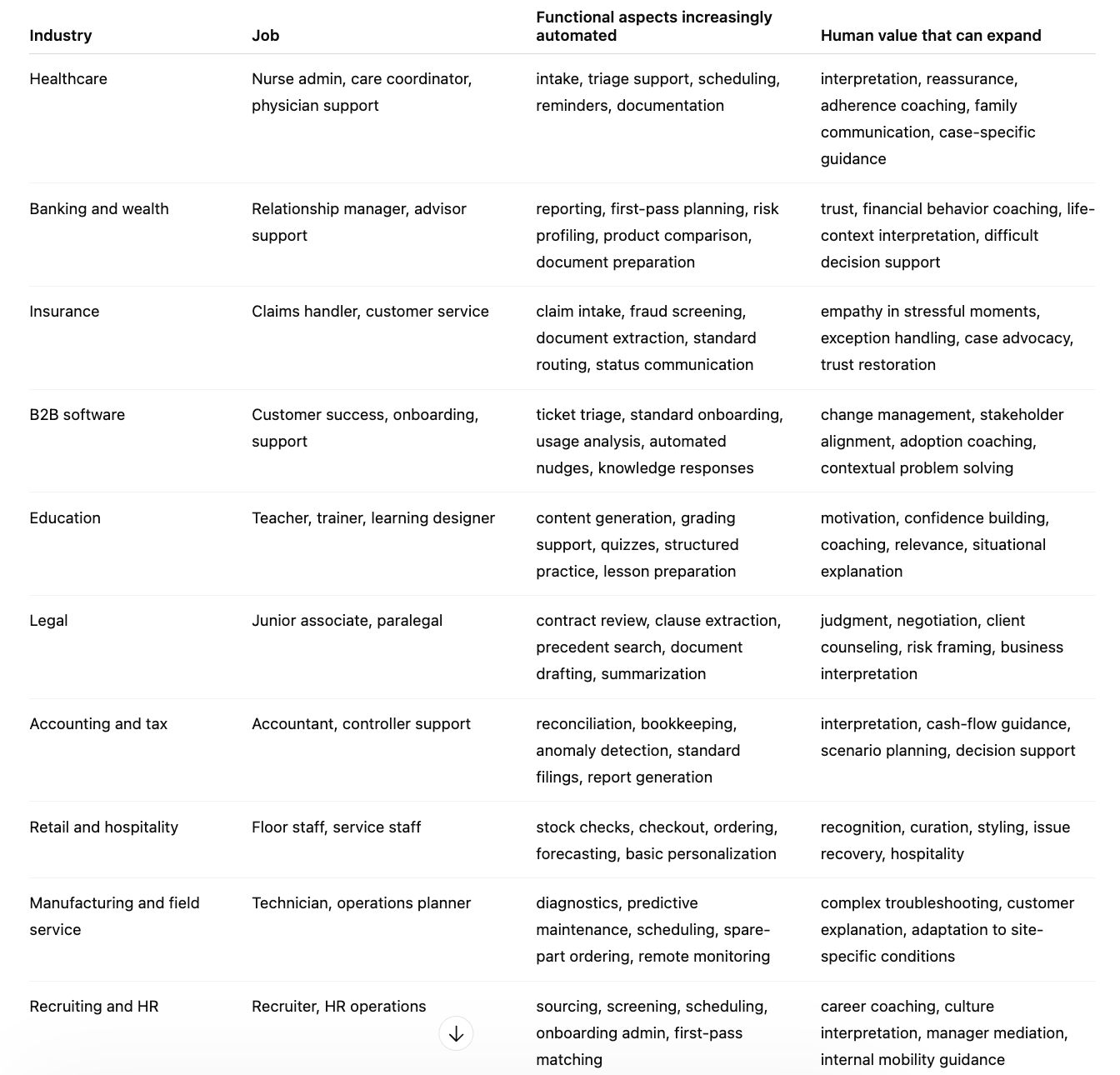
In healthcare, fewer people doing intake and documentation creates more capacity for interpretation, reassurance, and helping patients navigate a frightening diagnosis with someone who understands their specific case. In financial services, less time producing standard reports frees more time for helping clients make difficult choices without panic or confusion. In B2B software, less manual onboarding creates more capacity for the stakeholder alignment and change management that actually determines whether a product gets used. The pattern holds across every row: automation absorbs the repeatable layer and the valuable remainder moves toward the relational and situational.
The question that changes the analysis
The five-job framework becomes most useful when teams stop using it only to sharpen the functional job and start using it to map the full terrain of what a customer is actually trying to navigate.
“Not just: what task are we helping with? Also: how is the person trying to move through this situation, with these fears, these social pressures, these constraints, and these stakes?”
That second question is the one synthetic personas cannot reliably answer. Research cited in ACM’s analysis is clear on this: AI-generated personas help understand patterns in structured tasks, but struggle to capture unpredictable human behavior, reflect biases in training data, and cannot produce the qualitative depth that comes from observing real people making real decisions under real pressure. The insight that changes a product direction tends to come from a conversation with a specific person who surprises you. That surprise is the signal. It cannot be generated from a demographic profile or inferred from historical data without losing the part that matters.
This is what the AI-powered innovation workflows I keep seeing tend to skip. They optimize the functional discovery process and produce faster, cheaper outputs at the task level. But they hollow out the relational and situational intelligence that makes a product fit a real customer rather than a constructed one. The output is efficient. The understanding underneath it is thin. That thinness does not always show up immediately. It shows up when the product hits the market and the user it was designed for does not quite recognize themselves in it.
Where the advantage actually moves
The firms that will find a durable position are not those that automate the most. They are those that know where automation helps, where human judgment still changes the outcome, and how to combine the two into an offer that addresses what customers cannot get from a standardized system.
“In an age of standardized intelligence, advantage moves to what still must be human: recognizing the person, not just the pattern, and adapting to the situation, not just the average.”
The evidence behind this is getting specific. Edelman’s 2024 Trust Barometer found that global trust in AI companies fell from 61 to 53 percent between 2019 and 2024, and from 50 to 35 percent in the US. A 13-experiment study published in Organizational Behavior and Human Decision Processes by Schilke and Reimann (2025) found that disclosing AI use systematically erodes trust, even when the AI output is high quality. Brynjolfsson, Li, and Raymond (2025) found that AI raises the floor of performance -- improving novice output by 34 percent -- but leaves top performers nearly unchanged. In other words, AI compresses the gap between average and good. It does not compress the gap between good and trusted.
That last distinction is structurally important for where competitive advantage sits. Customers may use standardized platforms. They may accept automation at many touchpoints. But they do not want to feel interchangeable. A founder wants advice that fits the actual company, not a generic growth playbook applied to a situation it was never designed for. A patient wants to feel that someone is thinking about their specific case. A buyer wants support that takes their internal politics seriously. Even when needs are statistically common, people experience them as personal, local, and consequential. That is why relational and situational jobs are not decoration around the real product. In markets where functional delivery is increasingly commoditized, they become the product.
What innovation teams should do differently
Stop treating user contact as a cost to be reduced. Synthetic personas and AI-generated research are useful supplements for hypothesis generation and early exploration. They are not substitutes for the situated, contextual intelligence that comes from a real conversation with a specific person who surprises you. Use automated tools for the repeatable 80 percent of discovery. Protect the remaining 20 percent where the real decision texture lives.
Then ask which parts of the customer’s progress are becoming cheap and widely available, and which parts still drive trust, willingness to pay, retention, and advocacy. Redesign where human effort goes in response to that map. The teams that do this well will find that automation did not shrink the meaningful work. It relocated it toward interpretation, contextual guidance, trust-building, and decision support under uncertainty -- precisely the dimensions the five-job framework captures and precisely the ones that AI handles least well.
When everyone can build more, the harder advantage is knowing what people still need from another person.