


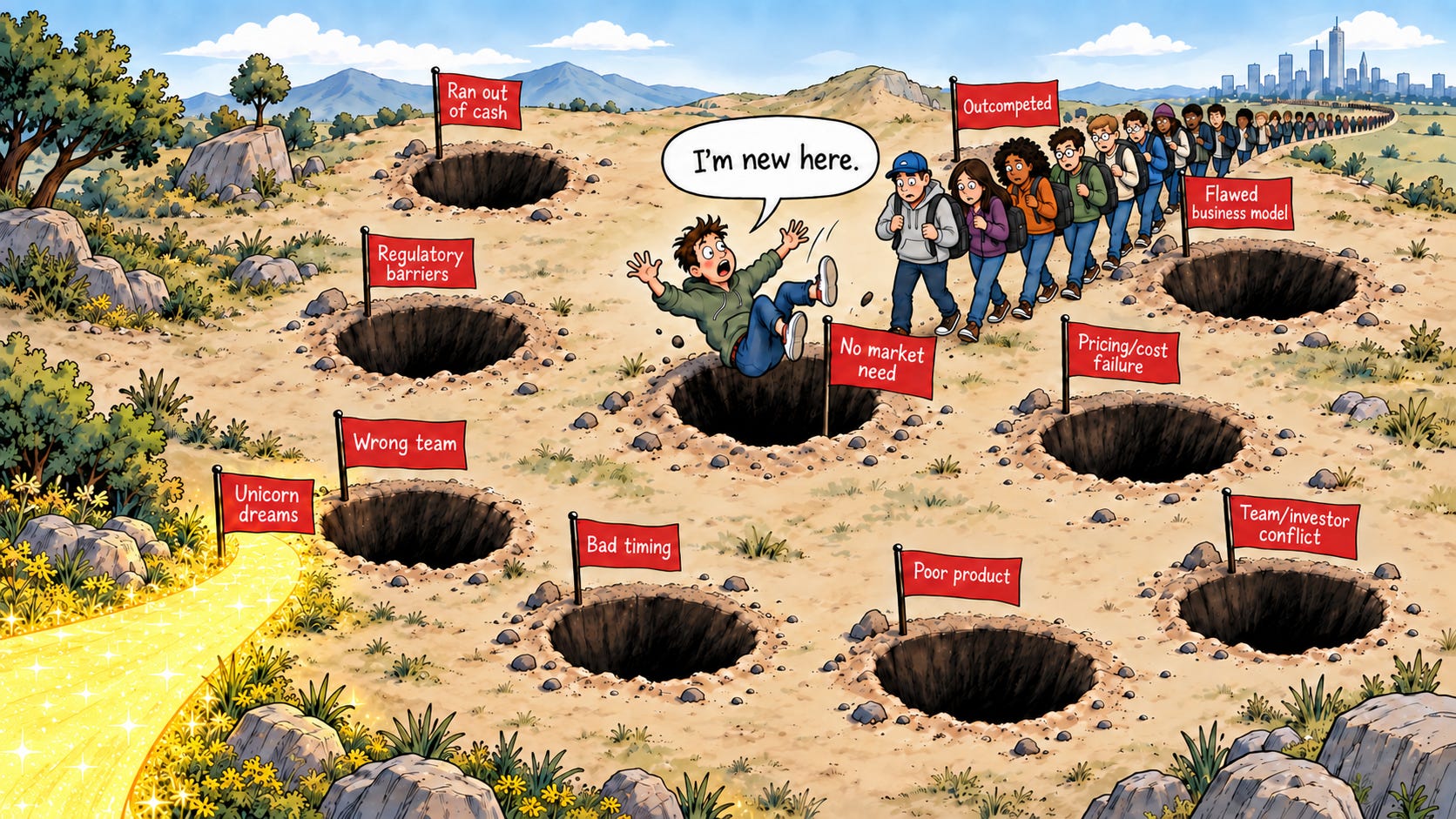
Three corporate customers are enthusiastic about a startup’s product. All three have completed pilots. The founders interpret the feedback as evidence that demand is building, so they hire their first two salespeople and increase development spending.
Months later, sales remain elusive. The users who loved the pilots never had purchasing authority. No budget had been approved, and the company’s team had not established how a buying decision would actually be made.
The founders thought they were investing to remove a sales-capacity constraint. In fact, they had yet to establish whether there was a commercially viable opportunity to sell into.
This is a hypothetical case, not a claim about any particular company. But it captures a distinction that founders before them have encountered at considerable cost: enthusiasm from users is not the same as evidence of an organization’s willingness and ability to buy.
Somewhere, another founder may already have learned that lesson. Why should the next one need to discover it through another expensive commitment?
When the People Leave, Their Experience Often Goes With Them
I began thinking about this while reading Learning from Failure When Failure Isn’t an Option, a 2025 chapter by Jerry Guo, Laura Patterson, and Mie Augier. Drawing on interviews with US Marine officers, the authors examine how personnel rotations and an aversion to failure can obstruct organizational learning. [1]
In a separate interview conducted by Augier and Sean F. X. Barrett, retired General Anthony Zinni describes a related problem with continuity across political administrations:
“we don’t do a good job of passing anything forward.” [2]
Zinni is talking about government and military leadership, not entrepreneurship. Those institutions are not interchangeable. What carries across is a narrower problem: people make consequential decisions, learn from their consequences, and leave before that experience can inform the next decision-maker.
Startups are particularly exposed to this loss. A venture closes, a team disperses, and the reasoning behind its decisions is divided among former founders, employees, investors, and advisers. Even when the venture survives, people move on, memories become simplified, and the circumstances that once made a decision seem reasonable are forgotten.
New founders may have more access to entrepreneurial education, methods, accelerators, and mentors than their predecessors. Yet access to advice is not the same as access to the specific experience needed before a particular decision. The critical insight may exist in the ecosystem but reach the next founder only after the commitment has become expensive to reverse.
Not Every Costly Failure Was an Avoidable Mistake
A startup cannot eliminate uncertainty by consulting experienced people. Whether a novel technology will work in an unfamiliar setting, whether customers will change their behavior, or whether a new business model can generate enough contribution to cover its costs may be genuinely unknown.
Learning those things sometimes requires an experiment that fails. If a team set a reasonable loss limit, tested an important assumption, and obtained useful evidence, the money was not necessarily wasted. A negative result may be the information that prevents a much larger loss.
But there is a difference between paying to discover something nobody knew and paying because a team treated weak evidence as stronger than it was.
In the opening example, the founders could not know in advance whether enough customers would eventually buy. They could, however, have recognized that successful pilots did not establish who controlled the budget, what procurement required, or whether the proposed price could support a viable business. That recognition might have changed what they investigated before hiring.
This distinction matters for investors, too. An unsuccessful venture is not proof of poor judgment, and a successful one is not proof that every decision was sound. The useful question is whether the commitment was justified by what was knowable at the time, including which important assumptions remained untested.
Experienced founders can help here without pretending to possess answers. They can identify a question their younger selves failed to ask, an explanation they dismissed too quickly, or a signal they misread. Their experience has value when it improves another founder’s judgment before resources are committed.
Interested in working together?
The Story Is Not the Lesson
There is an uncomfortable catch: people who have lived through an outcome are not necessarily good at explaining what caused it.
A founder may believe an early hiring decision killed the business when the real constraint was a weak value proposition or an unexpected change in regulation. A successful entrepreneur may credit disciplined execution while underestimating favorable timing, access to a particular customer, or luck. Both accounts can be sincere. Neither is automatically a reliable guide to a different venture.
Wolfgang Lattacher and Malgorzata Anna Wdowiak’s systematic review of entrepreneurial learning from failure points to a related research gap: we still know too little about how entrepreneurs turn what happened to them into logically sound conclusions. Reflection is not the same as accurate causal explanation. [3]
Nor is an explanation automatically transferable. A founder selling to small businesses may have learned to close deals in one conversation. A company selling to multinational organizations faces a different configuration of budget ownership, legal review, organizational incentives, and procurement cycles. Applying the first founder’s rule without examining those differences could create another mistake rather than prevent one.
Linda Argote and Paul Ingram’s research on organizational knowledge transfer helps explain why this is difficult. Useful knowledge is often embedded in the interaction of people, tasks, and tools, rather than in a sentence that can be detached from its setting and used anywhere. [4]
That gives us a stricter standard for entrepreneurial advice. I would want to understand what the founder believed before acting, what evidence was available, what alternatives they considered, what changed their mind, and which other explanations might account for the outcome. I would also want to know the conditions under which their experience stops applying.
The founder’s reputation, exit valuation, or failure story cannot answer those questions on its own. The quality of the reasoning matters more than the drama of the outcome.
An Accelerator Should Transfer Decisions, Not Just Introductions
Incubators and accelerators are well placed to do something about this. They see successive cohorts make similar decisions: whether to build a feature, price a product, hire salespeople, enter a market, or invest in scaling. They may retain relationships with founders after the ventures themselves disappear.
Yet counting workshops, mentors, and networking sessions tells us little about whether the next cohort makes better decisions. A mentor directory organized by sector or seniority might help people connect. It does not ensure that a founder about to expand sales capacity meets someone who has already mistaken pilot enthusiasm for purchasing intent.
The case for context-sensitive mentoring is not merely intuitive.
In a randomized study of inexperienced women running microenterprises in Kenya, Wyatt Brooks, Kevin Donovan, and Terence R. Johnson found that businesses assigned local entrepreneurial mentors earned, on average, about 20 percent higher weekly profits than the control group over the 17 months after the intervention. The effects weakened as mentoring relationships dissolved. General business classes changed some practices but did not produce a comparable profit increase. [5]
That is meaningful evidence for the value of locally relevant knowledge in the setting studied. It is not proof that an accelerator can prevent repeated mistakes in venture-backed technology startups, nor that every mentor’s explanation is correct. The external conditions and outcomes differ.
A more useful learning infrastructure would preserve not only what happened to previous ventures but the decision context: the assumption being made, the evidence available at the time, the alternatives considered, the commitment at stake, and the discovery that changed the team’s understanding. Those records would be made available when a new founder faces a comparable decision, not merely stored in a database. And the institution would examine whether using them changed decisions and results, rather than assuming that access counts as learning.
This is not a case for turning old experiences into rigid rules. It is a case for making them available as specific, challengeable accounts. A failed founder may have more to teach about an unnoticed buying constraint than a highly successful founder whose market never presented that constraint.
Facing a decision under uncertainty?
Before you commit more capital, credibility, or resources, let’s examine what you know, what you assume, and what evidence would justify your next move.
I work with founders, executives, and teams on decisions about what to test, scale, or stop.
Available online worldwide and in person across Europe.
Request a 20-minute introductory conversation.
What the Next Generation Should Not Have to Buy Again
I cannot credibly estimate the money, time, or credibility that better knowledge transfer could save. Some apparent mistakes become obvious only in hindsight. Some advice would be ignored. Some lessons would be wrong, or wrong for the next context.
But those limits do not erase the distinction. Entrepreneurship requires founders to pay for new knowledge. It does not require them to remain unaware of what others have already discovered about common errors in reasoning and commitment.
The question for an entrepreneurial ecosystem is not whether it can prevent failure. It is whether experience acquired at great cost reaches the next consequential decision while there is still time to use it.

INNOVATION& Paid — The 10-Minute Applied Masterclass
Learn how to separate a useful founder warning from evidence that justifies a decision, then turn one lesson from someone else’s venture into a specific test and a Proceed–Adapt–Stop rule for your own next commitment.
Four minutes to learn the distinction. Six minutes to apply it. You finish with a decision gate you can actually use.
