



Imagine walking into your HR department tomorrow and realizing that many of the skills you spent years mastering are no longer scarce. Screening candidates, scheduling interviews, processing payroll, managing benefits — all of it can now be done faster, cheaper, and more consistently by AI.
For many HR professionals, this feels like a threat to relevance. But that reaction misses the deeper shift.
This is not a story about technology replacing people. It is a story about jobs moving. When machines reliably perform certain jobs better than humans, those jobs do not disappear. They relocate — and they leave behind a vacuum of human effort that must be deliberately refilled.
Today, most HR teams are still stuck on the wrong side of that shift. They spend most of their time executing operational work, while the work that actually shapes culture, trust, leadership, and long-term capability gets pushed into the margins.
The real promise of AI in HR is not efficiency. It is leverage. The opportunity to redirect the same human capacity toward work that only humans can do — and that organizations increasingly depend on.
Reframing Roles and Jobs in HR
To understand this transformation, we must distinguish between roles and jobs. A role—HR manager, recruiter, or benefits specialist—is a label. A job, in Jobs-to-be-Done (JTBD) terms, is the outcome that an organization needs: hiring the right talent, building culture, supporting growth, resolving conflicts, and aligning workforce strategy with business goals.
AI excels at jobs that are repetitive, structured, and outcome-driven, such as resume screening, interview scheduling, payroll processing, and benefits administration. In these areas, AI can outperform humans in speed, accuracy, and consistency.
Yet most HR teams still spend the majority of their day performing these tasks manually. The potential to free humans for higher-value work exists, but it is largely untapped. This gap between potential and daily reality is where the true opportunity lies: by offloading operational work to AI, HR teams can finally focus on the human-centered jobs that create strategic impact.
HR Jobs Where Humans Drive Maximum Value
When AI handles routine work, HR professionals are freed to focus on jobs that machines cannot replicate—those that require judgment, empathy, and relational intelligence. These include:
Strategic Workforce Planning: Using AI-generated insights, humans can design workforce strategies aligned with evolving business goals, anticipating skill gaps and future talent needs.
Culture and Engagement Design: Machines can measure engagement or churn risk, but humans build trust, craft meaningful experiences, and embed organizational values into daily work.
Leadership Coaching and Development: AI can track performance metrics, but human coaches inspire growth, guide career paths, and mentor leaders.
Conflict Resolution and Employee Relations: Human judgment is essential for mediating disputes, restoring trust, and fostering a psychologically safe work environment.
AI Governance and Oversight: Humans define ethical boundaries, manage bias, and ensure that automation aligns with organizational principles.
Human-AI Orchestration: Professionals interpret AI outputs, make contextual decisions, and turn insights into actionable strategies.
By focusing on these jobs, HR teams can create far more impact than before, without increasing headcount. Automation becomes a lever for transformation, not a threat to existing roles.
Mapping HR Jobs Through a JTBD Lens
To make this more tangible, consider how AI can augment HR jobs while humans focus on higher-value outcomes:
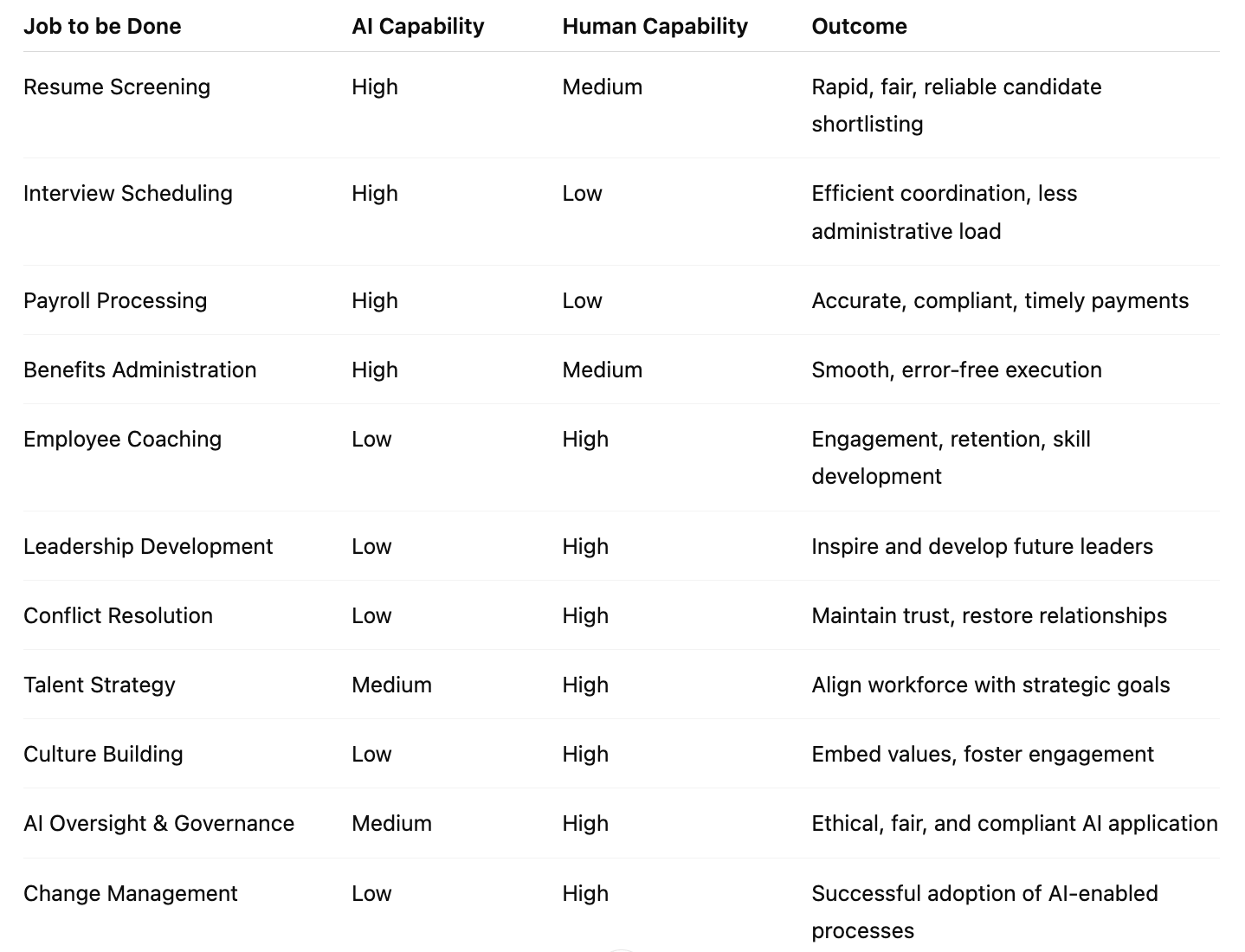
This mapping highlights the opportunity for strategic impact: AI handles operational efficiency, while humans focus on jobs that directly create human and organizational value. With the same workforce, HR can now drive a transformational shift in impact.
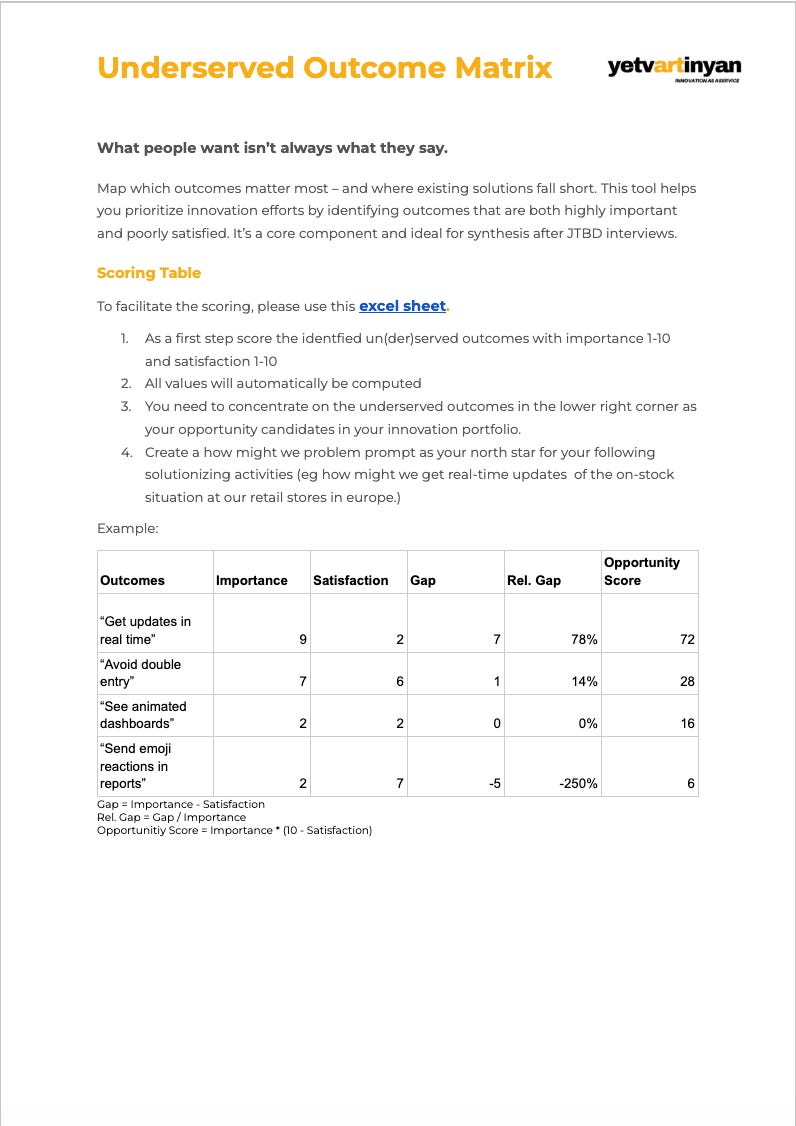
Stop guessing what your employees or customers really need. The Underserved Outcome Matrix helps HR teams and organizations identify high-value jobs and unmet outcomes, so you can focus your efforts where humans create the most impact. Turn insights into action, optimize workflows, and unlock the full potential of your team.
Grab your copy here: Underserved Outcome Matrix
AI as an Accelerator, Not a Replacement
A crucial insight is that automation is not a threat—it is a lever to amplify human value. By taking over repetitive, low-value jobs, AI enables HR teams to redirect effort and expertise toward high-impact, human-centered work.
In daily life, this shift is still largely missing. Many HR professionals remain burdened by administrative work, leaving little room for coaching, culture-building, or strategic workforce planning. But imagine the possibilities when operational tasks are automated:
HR professionals could spend more time mentoring managers to become better leaders.
Employee engagement initiatives could be planned and executed with more focus and creativity.
Strategic workforce insights from AI could be translated into actionable decisions that shape the future of the organization.
The same workforce, freed from routine tasks, can create far greater value than ever before. This is the transformational power of AI in HR: it does not replace humans—it unlocks their potential.
The Inflection Point: When Jobs Move Faster Than Roles
From a Jobs-to-be-Done perspective, inflection points appear when a system crosses a threshold: machines consistently outperform humans at specific jobs, and reverting no longer makes sense.
HR is already past several of those thresholds. Resume screening, scheduling, payroll execution, benefits administration — in these jobs, AI is no longer experimental. It is structurally better.
The inflection point is not about adoption. It is about consequence.
When organizations continue to allocate human effort to jobs that machines now perform better, they are not preserving value. They are misallocating it. Human capacity gets trapped in low-leverage work, while high-leverage human jobs — sensemaking, trust-building, judgment, coaching, ethical oversight — remain underinvested.
At this point, standing still is a decision. And it is an expensive one.
Organizations that recognize the inflection can make a different move:
Automate decisively where AI outperforms humans
Explicitly redesign human roles around judgment, empathy, and strategy
Treat AI outputs as inputs to human decision-making, not substitutes for it
Rewire HR workflows around outcomes, not tasks
The result is not a smaller HR function. It is a more consequential one. The same team, with the same headcount, operating at a completely different level of impact.
Inflection points do not reward caution. They reward clarity.
Trust and Human Oversight
Even as AI handles operational work, human oversight remains essential. HR professionals interpret outputs, resolve exceptions, and ensure that automation aligns with organizational values. Trust in AI enhances human judgment rather than replacing it.
This oversight is itself a high-value job. By interpreting AI recommendations, HR teams can maintain fairness, prevent bias, and ensure ethical application, reinforcing the uniquely human contribution within an AI-augmented department.
Redefining HR Careers in an AI-Enabled World
The rise of AI in HR opens new career opportunities, rather than eliminating them. Success will go to professionals who can:
Interpret AI outputs and translate insights into strategy.
Mentor, coach, and develop leaders.
Shape organizational culture and employee experience.
Govern AI applications ethically and effectively.
Orchestrate human-AI workflows to maximize impact.
By embracing these roles, HR professionals move from administrative execution to strategic influence, amplifying human value without increasing workforce size. Automation is not a threat—it is a multiplier for impact.
“When machines take over routine work, humans gain the space to shape culture, leadership, and purpose.”
Strategic Leadership Imperatives
For HR leaders and executives, AI should be seen as an enabler of transformation:
Map jobs, not titles. Identify tasks suited for automation and the high-value jobs that remain human-centered.
Redesign HR around outcomes. Focus the workforce on jobs that require judgment, creativity, and relational skills.
Invest in orchestration skills. Equip HR professionals to manage AI outputs, exceptions, and ethical considerations.
Develop new roles. Create positions in culture, coaching, AI governance, and strategic workforce planning.
Communicate purpose. Show HR teams how automation frees them to focus on work that truly matters.
Organizations that follow this path do more than adapt—they transform HR into a driver of organizational strategy and human value.
The JTBD Perspective: Seeing Beyond Replacement
From a JTBD lens, the question is no longer “Will AI replace HR?” The right questions are:
Which HR jobs can AI perform better, and which require human judgment?
How can humans focus on high-value jobs that directly shape culture, engagement, and strategy?
How can humans and AI work together to achieve superior outcomes?
Automation is not a threat. It is an opportunity to unlock human potential, allowing the same workforce to deliver greater impact than ever before.
Designing the Future of HR
The future of HR is human-AI co-creation. AI handles operational efficiency. Humans focus on high-value work: culture, engagement, leadership, strategy, and oversight. Together, they amplify organizational outcomes.
This is a shift from managing tasks to creating outcomes, from transactional HR to transformational HR. The same workforce, empowered by AI, can achieve far more and create value where it matters most.
The lesson is clear: AI is not the end of HR. It is the beginning of a new chapter, one in which HR professionals are freed to focus on the work that only humans can do—and in doing so, drive unprecedented value for the organization.

If you want to unlock the full potential of your HR team, design AI-augmented workflows, or explore how Jobs-to-be-Done can transform your people operations, let’s talk. I work with HR departments to identify high-value jobs, optimize human-AI collaboration, and deliver practical training that turns insight into action. Reach out to discuss how we can make your HR function more strategic, human-centered, and impactful.