


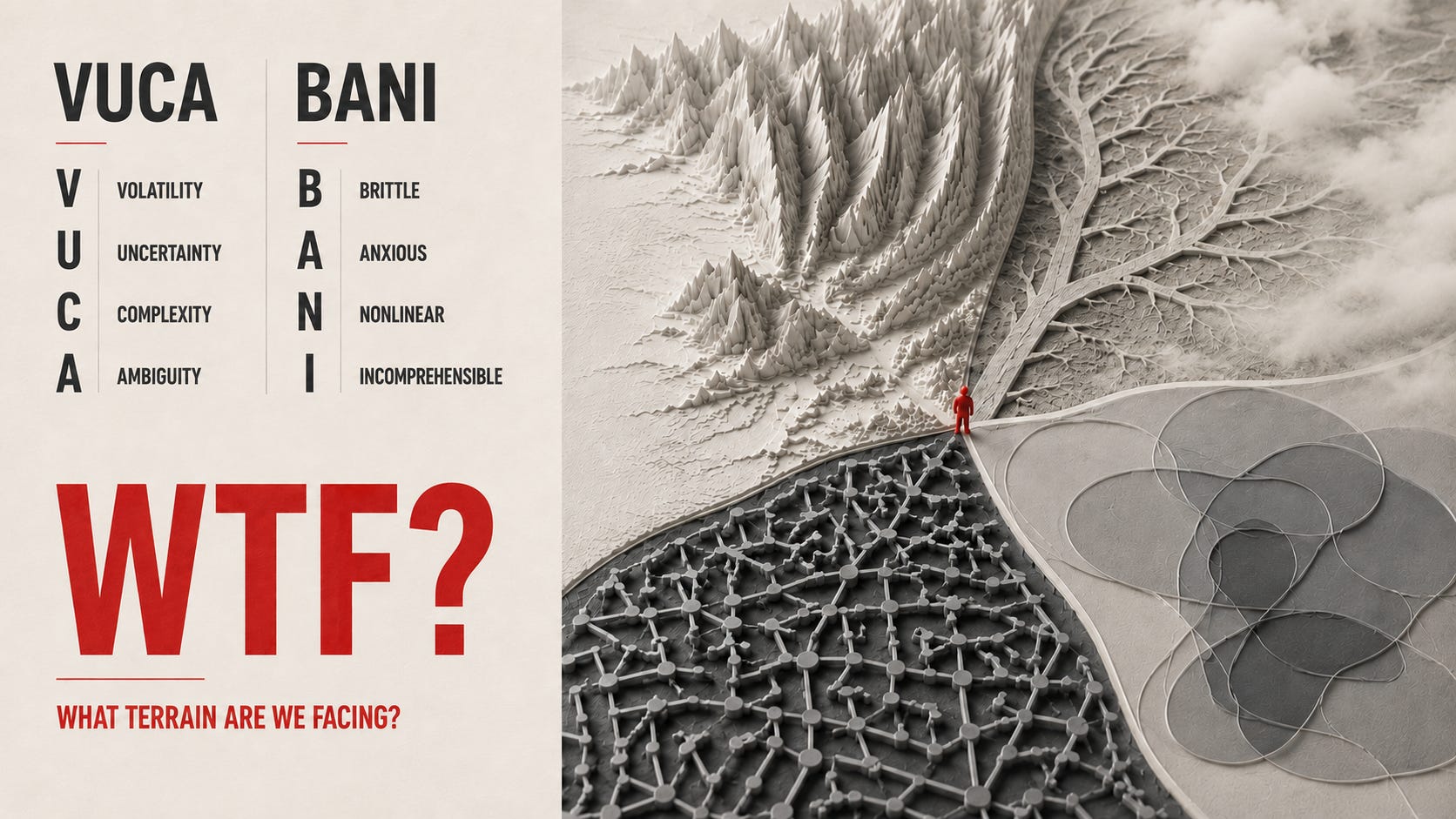
During my last studies, I heard the same sentence from lecturers until it came out of my ears: “We live in a VUCA world.” At some point, I began asking what that actually meant.
It appeared in courses on strategy, management, digital transformation, and innovation. Later, BANI joined the vocabulary. Yet the acronyms rarely led to a precise discussion of which condition we were facing, what it prevented us from knowing, or how it should change the way we made decisions.
Contemporary management education can no longer be described fairly as teaching only long-term planning, financial analysis, and optimization. The programs I encounter now combine traditional management disciplines with strategic foresight, behavioral economics, data analytics, digital technologies, business-model innovation, entrepreneurship, design methods, agile development, experimentation, research methods, and applied projects.
This is a much richer education. The problem is not a shortage of modern methods.
The problem is that approaches based on different assumptions about the decision environment are often taught alongside one another without making their boundaries sufficiently explicit.
Long-term planning and expected-return calculations assume that alternatives, consequences, and probabilities can be bounded well enough to compare them. Data analytics assumes that available data contains patterns that remain informative for the decision ahead. Strategic foresight weakens dependence on a single prediction by examining several plausible futures. Experiments assume that a relevant hypothesis has been framed and that an observable result can distinguish it from alternatives.
Design inquiry and abductive reasoning become important when the problem, desired outcome, or causal explanation remains unclear. Effectuation begins from available means and affordable loss when prediction is not credible. Agile development helps teams adapt delivery as feedback emerges, but it does not determine whether the right problem, hypothesis, or commitment has been selected.
Each approach can be rational. They are not rational under the same conditions.
Teaching them together does not automatically provide a logic for choosing among them. Students may learn how to construct a scenario, calculate an expected return, conduct an experiment, map a business model, build a prototype, or organize an agile team without first learning to diagnose which model of rationality fits the decision in front of them.
The unresolved issue is therefore not traditional management versus modern innovation. It is the coexistence of several decision logics whose assumptions and boundaries often remain implicit.
The result can be an extensive toolbox without an explicit selection rule.
Before reaching for VUCA, BANI, or another familiar approach, leaders therefore need to ask a more useful question:
WTF? What Terrain Are We Facing?
Only then can they determine which way of thinking, deciding, and acting fits the conditions.
When the acronym ends the diagnosis
The origin of VUCA is less certain than many presentations suggest. The U.S. Army Heritage and Education Center found the term in Army War College material dating back to 1987 but could not identify one definitive inventor.[1] It later became associated with the post-Cold War strategic environment and spread into business and management.
The criticism of its subsequent use is not new. Bennett and Lemoine argued that VUCA is frequently treated as a catchall even though its four elements represent distinct challenges requiring different responses.[2]
This is more than a problem of fashionable language.
Calling an initiative “VUCA” provides almost no decision value. It does not tell us whether customer behavior is unpredictable, the problem is poorly understood, the technology is fragile, organizational dependencies are blocking implementation, or the available options cannot be compared credibly.
Nor does it tell us whether we need more information, another explanation, a shorter commitment, a more robust architecture, or a simple rule for acting before the uncertainty can be resolved.
Naming four difficult conditions does not tell us which one is blocking the decision in front of us.
VUCA contains four different problems
The following distinctions are not a universal taxonomy. They are a practical starting point for diagnosis.
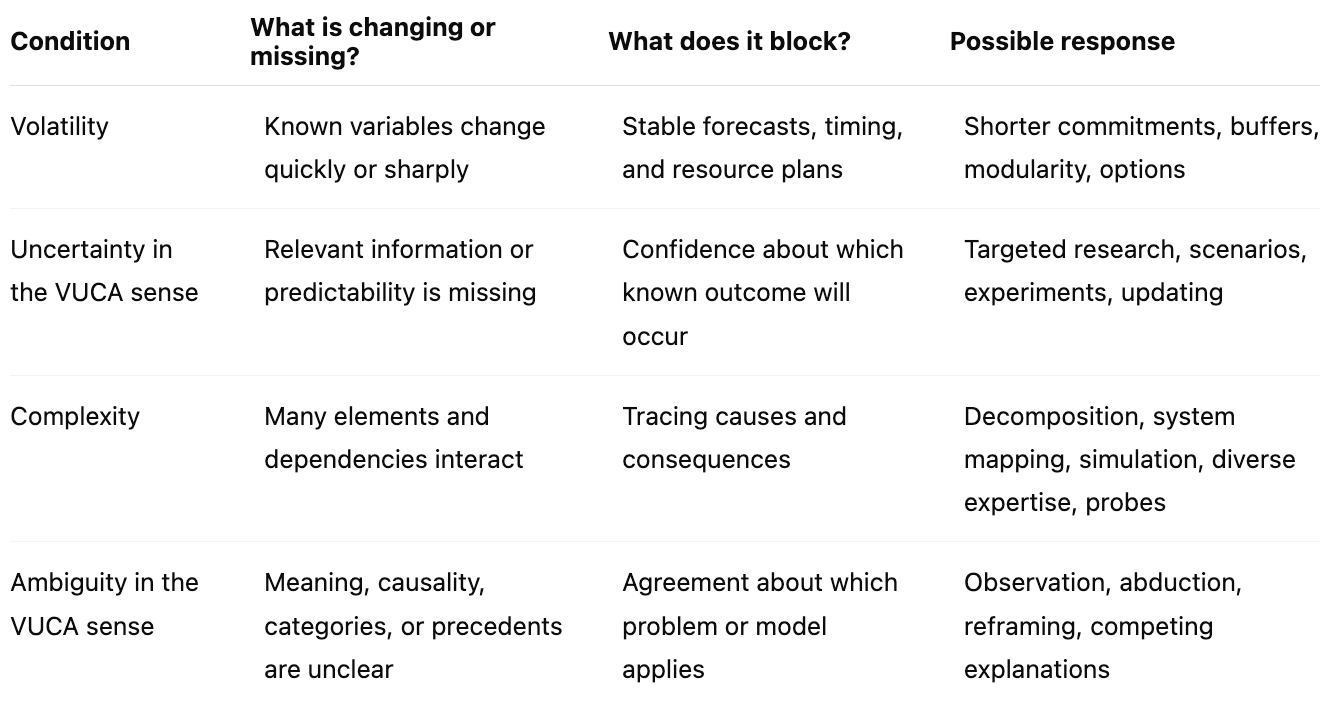
These conditions can coexist without becoming interchangeable.
An innovation initiative might involve a stable technology, an ambiguous customer problem, uncertain adoption, and a complex organizational implementation. One dependency might be fragile while another produces delayed or disproportionate effects.
The initiative is not simply “uncertain.” Different decisions inside it inhabit different environments.
This changes the question from:
Which methodology do we use for this initiative?
to:
What currently prevents us from making the next decision, and which mechanism could reduce that obstacle?
BANI does not solve the category problem
Jamais Cascio developed BANI in 2018 and published it publicly in 2020 as a way of making sense of conditions he believed VUCA no longer described adequately.[3] He later clarified that BANI was intended as a visceral and experiential sensemaking framework, not as a technical analytical model.[4]
That distinction matters.
The problem is not BANI itself. The problem begins when it is treated as an operating model.
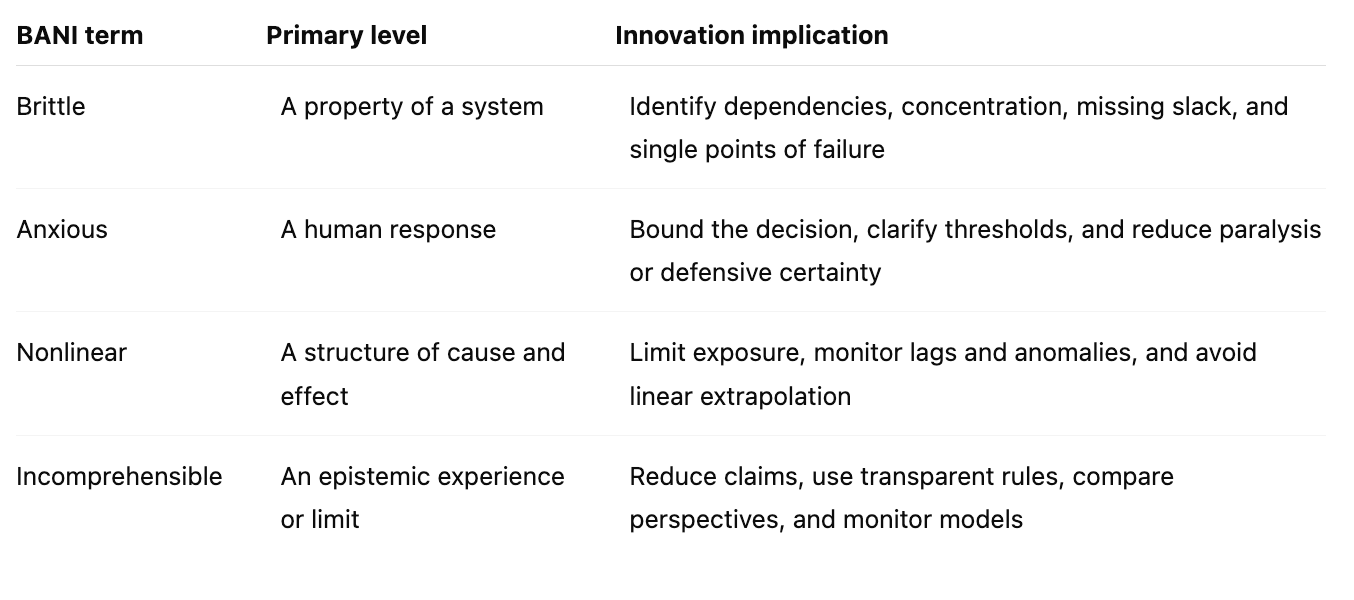
Brittleness is not the same kind of phenomenon as anxiety. Nonlinearity is not the same as incomprehensibility. One concerns the structure of a system, another the response of people, another causal behavior, and another the limits of understanding.
BANI may describe how a situation is structured or experienced. It does not by itself determine how an innovation decision should be made.
Interested in working together?
Ambiguity and uncertainty are not synonyms
The terminology becomes more difficult because the same words have different meanings across intellectual traditions.
In ordinary language and most VUCA discussions, ambiguity means unclear meaning, competing interpretations, or uncertainty about which causal explanation applies.
Pich, Loch, and De Meyer use ambiguity in project management to describe inadequate knowledge about states of the world or the causal effects of actions. Their framework distinguishes instruction, learning, and selectionism as responses to different information conditions.[5]
In decision theory, ambiguity has another meaning. Ellsberg demonstrated situations in which potential outcomes are bounded but decision-makers cannot assign credible probabilities to them. People frequently treat such situations differently from risks with known probabilities.[6]
Uncertainty has the same problem.
In common VUCA usage, uncertainty often means missing information or low predictability. In the tradition connecting Frank Knight, Leonard Savage, Herbert Simon, and Gerd Gigerenzer, uncertainty can refer to a more fundamental condition: the complete set of relevant future states and consequences is not known or knowable.
Before selecting a response, leaders therefore need to state which meaning they are using.
More data can reduce an information gap. It cannot necessarily resolve competing interpretations.
An experiment can distinguish between framed hypotheses. It cannot guarantee that the relevant hypothesis is among those being tested.
A scenario can explore several plausible futures. It cannot make the chosen possibility space exhaustive.
An optimization model can identify the best option inside its boundaries. It cannot establish that those boundaries include everything consequential.
The Small World behind traditional decision logic
Leonard Savage’s subjective expected utility theory provides a formal basis for choosing between alternatives when a decision can be represented as a Small World.[7]
A credible Small World requires:
a sufficiently exhaustive and mutually exclusive set of future states;
a sufficiently specified set of consequences;
a defined set of available actions;
preferences that permit comparisons;
and probabilities, or credible subjective probabilities, connecting actions, states, and consequences.
Under these conditions, expected utility and optimization can be appropriate.
They are not outdated simply because someone has declared the world VUCA. If insurance risks are known, costs are measurable, alternatives are bounded, and historical frequencies remain informative, formal decision analysis may be exactly what is required.
Optimization is not the problem. Applying it outside the conditions that make optimization credible is the problem.
Savage himself recognized its limits. He contrasted the bounded Small World with the unattainable Grand World and used planning a picnic and playing chess to illustrate situations in which exhaustive optimization becomes impossible or unreasonable.[7, 8]
The term Large World was adopted later for decision environments outside a credible Small World. It should not be attributed directly to Savage.[8]
Gigerenzer distinguishes four decision conditions that are particularly useful here.[8, 9]
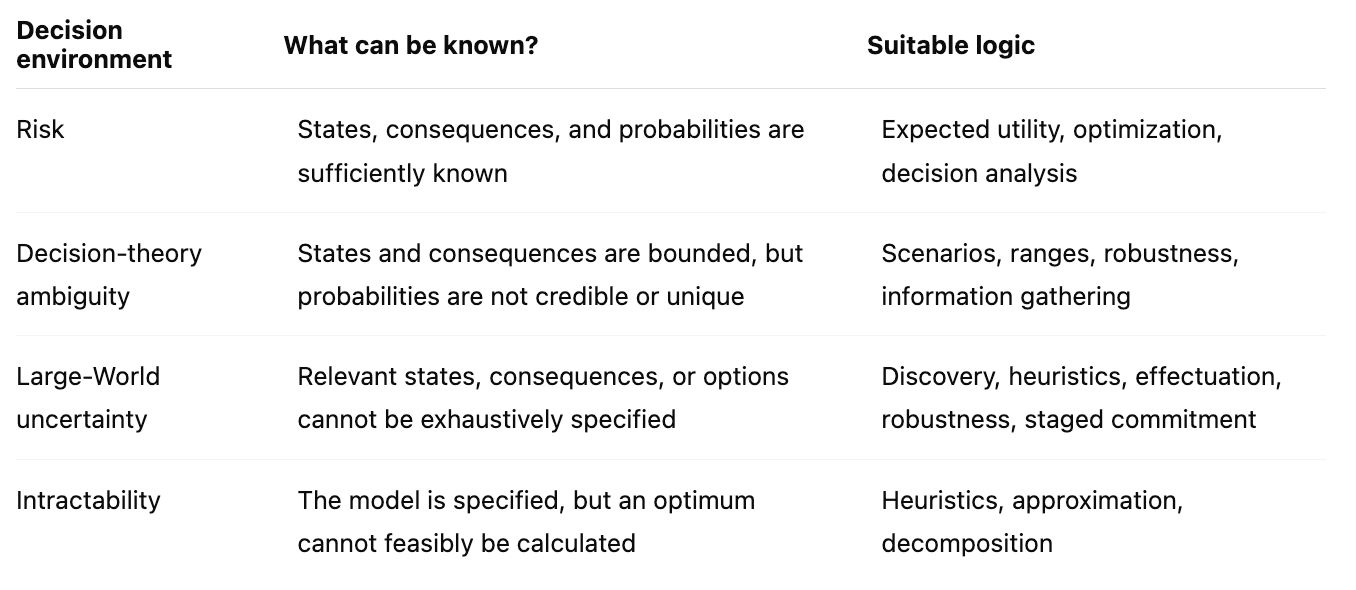
Complexity does not automatically imply uncertainty.
Chess is fully specified but computationally intractable. A new market can be difficult for a different reason: the relevant actors, uses, reactions, and consequences have not yet emerged.
A problem may also contain both. An innovation team might understand the rules of one technical system while remaining unable to specify how customers, regulators, competitors, partners, and internal units will respond to it.
Calling both situations “complex” conceals the difference.
Large Worlds require discovery, but not endless discovery
Large-World problems are often ill-defined because relevant states, consequences, options, or causal relationships remain unknown.
That does not mean that anything goes. Nor does it imply that a team should apply every available discovery method.
It means the decision process must remain capable of exposing something that was absent from its initial model.
This requires discovery mechanisms that can:
reveal unrecognized actors or outcomes;
identify anomalies and edge cases;
compare competing explanations;
challenge the original problem frame;
surface consequences outside the current model;
and revise the boundaries of the decision.
But discovery also needs constraints.
Without a decision, an aspiration threshold, or a stopping rule, teams can continue researching indefinitely. More interviews, workshops, prototypes, and experiments may increase activity without making the decision more ready.
Large-World uncertainty therefore requires two complementary capabilities:
enough openness to discover what the current model excludes;
enough discipline to make the next bounded commitment before the broader uncertainty disappears.
The objective is not to transform the entire Large World into one complete Small World. That is impossible.
The objective is to construct a sufficiently credible local Small World around the next decision while remaining alert to evidence that invalidates it.
Innovation creates local Small Worlds
An innovation initiative rarely moves as a whole from a Large World into a Small World.
Instead, teams construct temporary Small Worlds around particular decisions.
They may bound:
one customer segment;
one job or outcome;
one use case;
one technical configuration;
one channel;
one commitment period;
or one level of acceptable loss.
This boundary makes a decision possible. It does not make the broader uncertainty disappear.
The distinction matters because experiments also operate inside constructed frames. An experiment can test whether a stated hypothesis survives contact with evidence. It cannot automatically reveal a customer group, consequence, mechanism, or alternative explanation that the team never considered.
Experiments are therefore learning mechanisms, not universal discovery machines.
They work well when the relevant hypothesis has been framed. When the frame itself is ambiguous, observation, abductive reasoning, anomaly detection, and competing explanations may need to precede hypothesis testing.
Dorst’s work on design reasoning connects abduction with situations in which both the “what” and the “how” remain open.[10]
This produces a sequence that is often missing from method-first innovation:
discover or construct a plausible frame;
translate the frame into assumptions and hypotheses;
test what can be tested;
define what evidence is sufficient for the next commitment;
monitor for anomalies that reopen the frame.
Bounded rationality is not defective rationality
Herbert Simon challenged the idea that rational decision-makers must possess complete information, stable preferences, and unlimited computational capacity. His concept of bounded rationality treats the limits of the decision-maker and the structure of the environment as part of the decision problem.[11]
Satisficing is one response.
A satisficing decision-maker does not search for the best imaginable option. The decision-maker defines an aspiration level, searches sequentially, and stops when an option satisfies it.
This is not the same as accepting low quality.
The aspiration threshold can be demanding. What changes is the stopping logic. Search ends when an acceptable option has been found rather than continuing until every possible option has been evaluated.
A satisficing heuristic therefore needs at least:
an aspiration threshold;
a search rule;
a stopping rule;
and a decision rule.
This matters because innovation teams often treat additional information as inherently valuable. They conduct another interview, build another prototype, add another workshop, or extend the research phase without specifying what evidence would change the decision.
More learning activity does not necessarily produce more decision readiness.
Without a threshold and a stopping rule, “learning” can become an indefinite postponement of commitment.
Interested in working together?
Fast and frugal does not mean careless
A heuristic is a simplified decision rule that deliberately ignores part of the available information.
That sounds irrational only if rationality is defined as using all available information and calculating an optimum.
Ecological rationality asks a different question:
How well does the rule fit the structure of the environment?[8]
Research on heuristics in management shows that simple rules can be adaptive, particularly when information is limited, time matters, and the environment contains exploitable regularities.[12] Research on internationalizing ventures also indicates that organizations learn heuristics from repeated process experience rather than merely accumulating more data.[13]
Smart Management by Jochen Reb, Shenghua Luan, and Gerd Gigerenzer translates this research into an adaptive toolbox for leaders.[14]
The important word is adaptive.
An adaptive toolbox does not mean collecting as many innovation methods as possible. It means having a limited repertoire of explicit rules and understanding the environmental conditions under which each rule is likely to work.
A complex problem does not justify a complex method by default.
The relevant question is:
Which few cues, thresholds, search rules, and stopping rules retain decision value under these conditions?
Adding methods without a rule for selecting them merely moves the uncertainty from the venture into the process used to manage it.
The toolbox sits below the environment
The order matters.
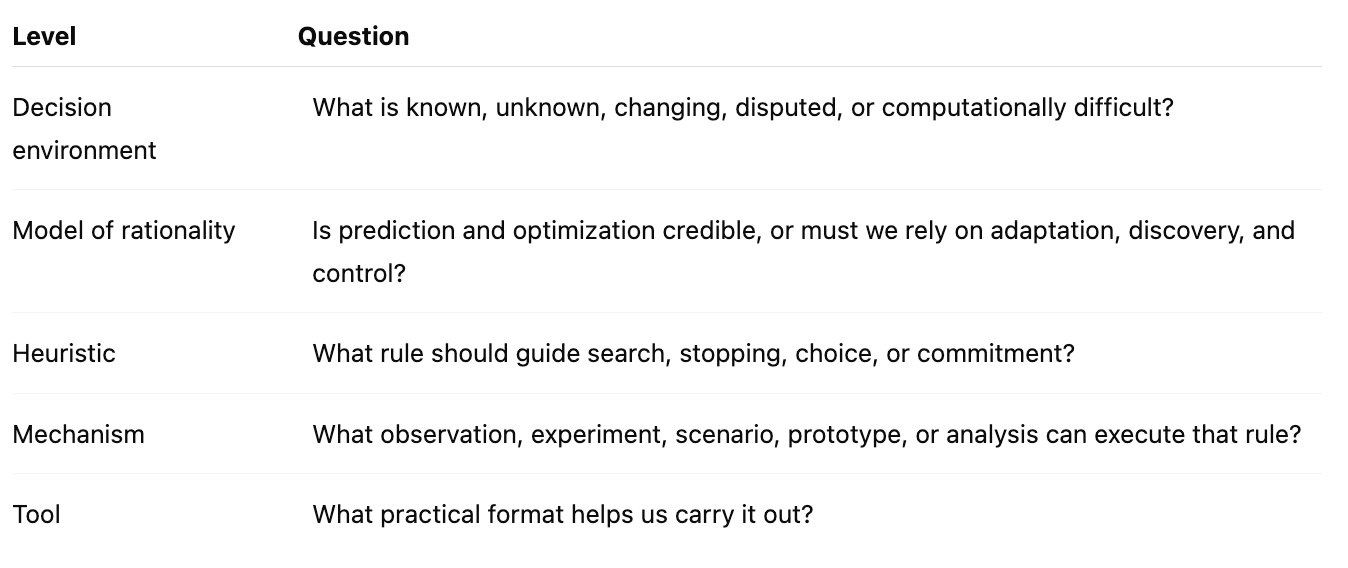
This reverses the usual innovation conversation.
Teams often begin with a favored method and then force the problem into it. They run a Design Thinking workshop, create a business-model canvas, start a sprint, or launch an experiment because that is how innovation is supposed to be done.
The alternative is not another universal framework. It is a more disciplined selection process.
The synthesis proposed here has not been tested as one integrated scientific theory. It draws together established research from decision theory, bounded rationality, ecological rationality, project uncertainty, entrepreneurship, design reasoning, and strategic experimentation.
It should therefore be read as an evidence-informed decision architecture, not as a claim that one new framework has solved innovation management.
Dinner is enough to see the difference
Imagine that several people need to decide what to have for dinner.
The decision appears simple, but “dinner” may represent different desired outcomes:
eating quickly;
spending time together;
celebrating something;
eating healthily;
avoiding cooking;
or accommodating dietary restrictions.
If one person immediately proposes pizza, the group may begin comparing toppings and delivery services before agreeing on what tonight’s dinner needs to accomplish.
That is ambiguity in the ordinary or VUCA sense. The frame is unclear.
A minimal discovery process might ask:
What matters tonight?
What is non-negotiable?
What would be good enough?
Once the frame is clearer, uncertainty may remain. The group may not know whether the ingredients are available, delivery will arrive on time, or everyone will accept a particular option.
It can then construct a local Small World:
a maximum budget;
a maximum preparation time;
dietary constraints;
and two or three feasible options.
A satisficing heuristic could be:
Search only among options that meet the hard constraints. Stop when one option reaches the agreed aspiration threshold. Choose it.
The group does not need to identify the best possible dinner available anywhere.
The commitment is cheap and reversible, so the evidence threshold should be low. If the choice turns out badly, the consequences are limited and another decision will follow tomorrow.
A major innovation investment requires a higher threshold because the consequences are larger and less reversible. The diagnostic sequence, however, remains the same.
What this changes in innovation work
Different blockers require different questions.
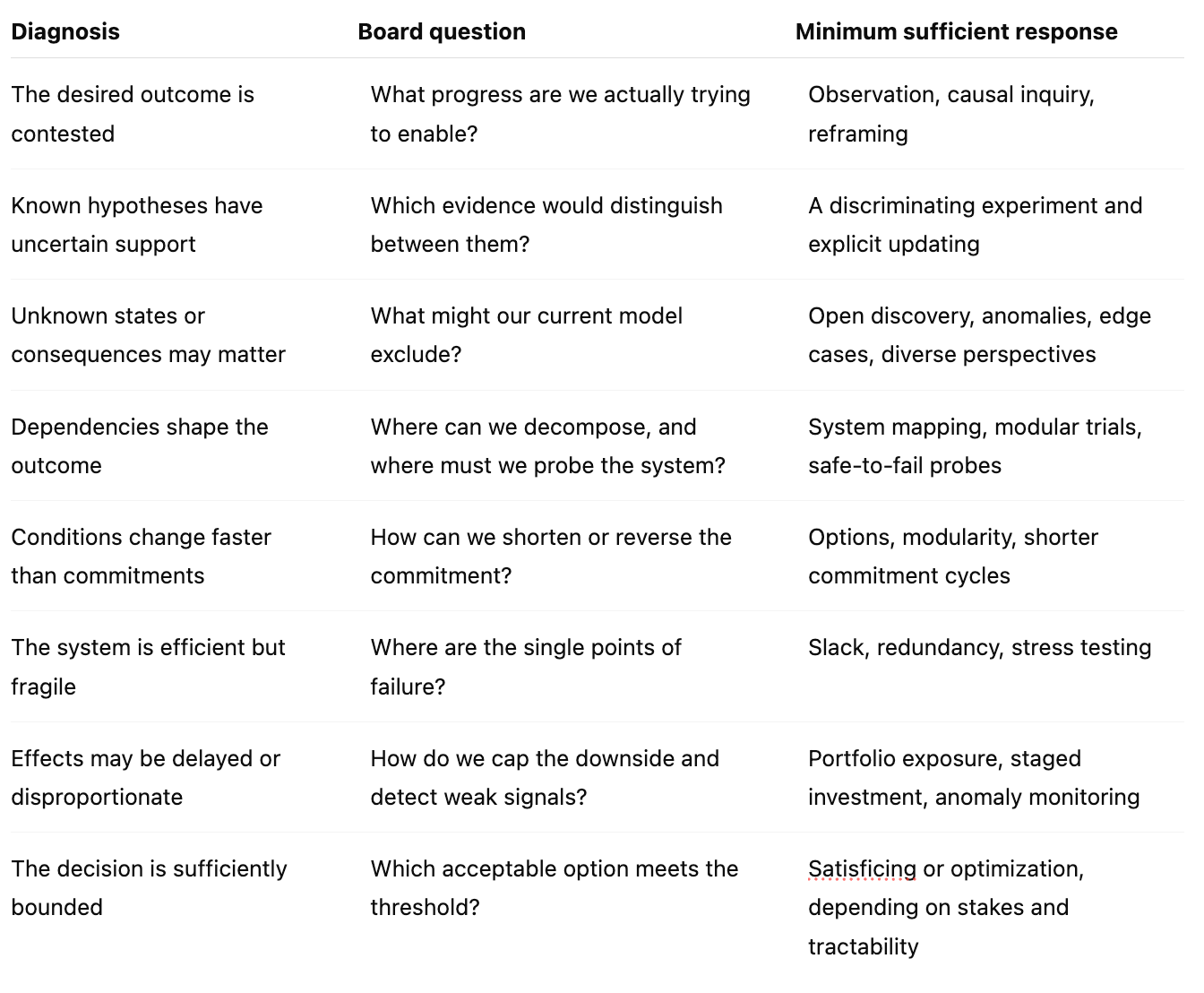
Under genuine uncertainty, effectuation replaces prediction with a logic of control: begin with available means, limit exposure through affordable loss, and work with commitments that can shape what happens next.[15]
Real-options reasoning adds another principle: preserve access to upside while limiting the cost of being wrong, and increase commitment only when evidence improves.[16]
Research on decision-making under deep uncertainty similarly favors robust and adaptive choices over strategies that are optimal under one predicted future.[17, 18]
None of these approaches eliminates uncertainty. They change how much must be assumed before action becomes rational.
The practical conclusion is straightforward:
Do not ask which innovation methodology the organization follows. Ask what kind of decision environment surrounds the next commitment, what currently blocks that decision, and which simplest credible mechanism could make it more ready.
The world is not the useful unit of diagnosis. The next consequential decision is.
The free section of INNOVATION& is offered freely, and you are welcome to keep reading it that way. If these articles help you make better decisions in your working life, please consider becoming a paid subscriber. Researching and writing them takes time, and paid subscriptions provide the income I need to continue. Your support also helps keep part of this work available to everyone.
Thanks for reading INNOVATION&! This post is public so feel free to share it.
Start paid learning and application section
The Decision Environment Diagnostic
The diagnostic begins with a live decision, not an initiative label.
Weak:
Our AI transformation is uncertain.
Decision-grade:
Should we fund a three-month pilot of an AI customer-service assistant for one customer segment?
The second formulation identifies an action, a commitment, a time boundary, and a decision owner. It can be examined.
