



TL;DR: Mature organizations develop an Optimization Immune System: the controls, standards, and governance routines that protect what has been proven. It is indispensable for scale, but dangerous when applied to opportunities whose customers, economics, or business models remain uncertain.
Organizations also need a Validation Immune System that protects them from large commitments based on untested assumptions. The real capability is knowing which system should evaluate a decision, what evidence should trigger a switch, and who can make that handoff.
The paid section applies the distinction to one investment decision and introduces a reusable Two-System Decision Charter with scale, pivot, stop, and handoff conditions.
Capable Organizations Usually Do Not Fail Because They Forget How to Execute
Successful organizations become successful by learning how to make important outcomes repeatable. They improve quality, remove waste, standardize work, strengthen controls, and reduce operational risk. This is not bureaucracy in the dismissive sense. It is accumulated organizational intelligence. An airline needs procedures that constrain improvisation; a pharmaceutical manufacturer needs validation and quality control. Scale depends on deciding which variation is useful and which is dangerous.
Yet the systems that make an organization dependable can also make it strategically brittle. The organization does not suddenly become unintelligent. It becomes highly intelligent within a set of assumptions that the environment may no longer respect.
James March described the underlying tension as exploitation and exploration. Both are necessary, but exploitation tends to produce clearer, nearer, and more measurable returns.[1] Later work on organizational ambidexterity developed the same challenge: mature organizations must run established businesses efficiently while creating the conditions for discontinuous innovation.[2] This is often summarized as a need to “balance” the present and the future, but organizations actually face two different survival problems requiring two different ways of deciding.
One problem is operational: How do we execute what we know with increasing reliability?
The other is epistemic: How do we discover whether what we believe is true before we commit too much to it?
Treating both problems with the same governance logic is how rigorous organizations produce rigorously unsupported decisions.
The Optimization Immune System Protects What Has Earned the Right to Scale
Every mature organization develops what I call an Optimization Immune System. It consists of the mechanisms that protect a validated operating model: budgets, investment committees, performance targets, quality standards, operating procedures, compliance requirements, forecast reviews, procurement rules, and accountability structures.
Its questions are familiar because they are usually the right questions:
Can the organization deliver this reliably?
Does the investment clear the required return?
Are costs, risks, responsibilities, and milestones understood?
Is performance on plan?
Can the process be standardized and scaled?
Who is accountable when delivery falls short?
These questions create enormous value once customers, demand, the offer, delivery, and the economic model are reasonably well understood. At that point, uncertainty should become disciplined execution, variation can be expensive, and consistency becomes an advantage. The Optimization Immune System protects the organization from operational failure. Without it, organizations do not scale; they improvise.
The danger appears when success quietly changes the system’s purpose. What began as a way to protect validated knowledge becomes a way to protect the assumptions beneath the current business. Existing customers shape priorities. Current margins define attractiveness. Established channels determine which opportunities appear reachable. Resource-allocation processes favor proposals that resemble businesses the organization already knows how to evaluate. Christensen and Bower’s study of the disk-drive industry showed how rational attention to powerful customers and established resource-allocation patterns could contribute to leading firms missing strategically important shifts.[3]
The system is still functioning, but it may be defending a model of the world that is losing relevance.
The Validation Immune System Protects the Organization From Becoming Confidently Wrong
A Validation Immune System performs a different function. It does not lower standards, suspend accountability, or create a sanctuary in which innovation teams can avoid commercial questions. Its purpose is to stop the organization from treating assumptions as facts simply because a decision is important.
Its questions therefore sound different:
Which assumption must be true for this opportunity to deserve further investment?
What do we know, what do we merely believe, and what remains unknowable at the current stage?
What observable evidence would increase or reduce our confidence?
What is the least expensive credible way to obtain that evidence?
What result would cause us to change the offer, the business model, or the strategic thesis?
What must become repeatable before optimization governance should take over?
The Validation Immune System protects the organization from strategic error. It converts uncertainty into bounded commitments designed to improve a decision. Discovery-driven planning made this principle explicit: new ventures should surface and test assumptions rather than present projections as facts.[4] Saras Sarasvathy’s distinction between causal and effectual reasoning similarly showed why decisions under genuine uncertainty cannot always begin with prediction.[5] Validation is not the permissive counterpart to optimization. It is disciplined skepticism applied before scale.
An early-stage opportunity usually lacks exactly what optimization governance expects: a stable customer definition, repeatable sales process, proven willingness to pay, reliable delivery model, or credible economics. These are unresolved questions, not administrative omissions that a polished business case can repair.
When an investment committee asks for a five-year forecast before those questions have been answered, the team still produces one. Prices are assumed, adoption curves are drawn, and margins converge toward the corporate target. The spreadsheet is not necessarily dishonest; it is a translation device. The team has learned that uncertainty must be converted into the language of certainty before the organization will fund the work required to reduce it.
The Difference Is Not Creativity Versus Control
The two immune systems are often misrepresented as cultural opposites: imagination and autonomy on one side, discipline and control on the other. Both systems require imagination and discipline, but apply them to different objects. Optimization disciplines execution, reduces unwanted delivery variation, and measures performance against a plan. Validation disciplines belief, creates bounded variation to learn, and evaluates whether evidence should change the plan. Neither is superior; each becomes dangerous when it governs the wrong decision.
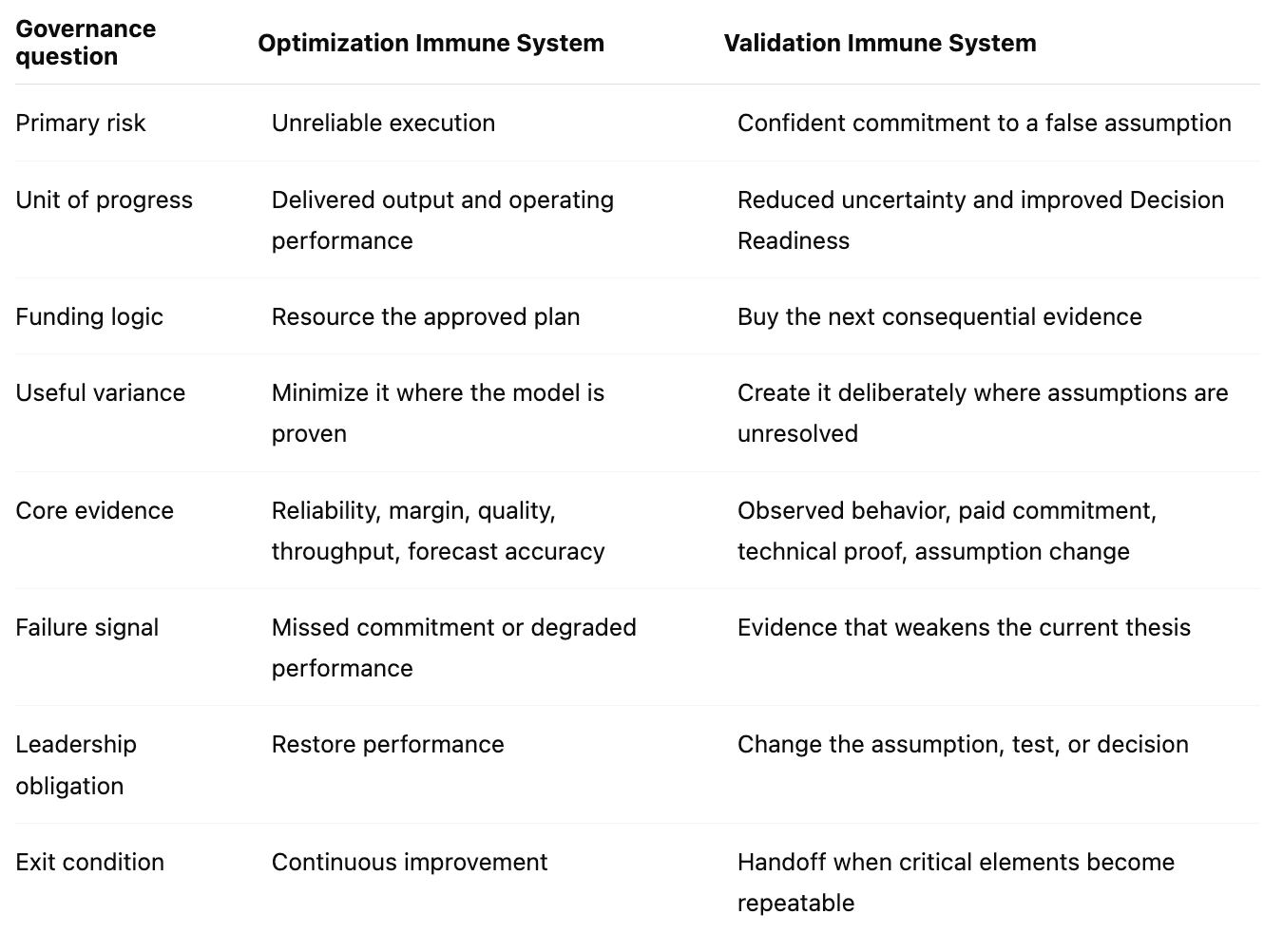
This table also exposes why installing an accelerator or innovation lab is insufficient. If the same budget cycle, return thresholds, performance metrics, and steering questions determine its fate, the organization has merely built an innovation room inside the first immune system.
The Hardest Problem Is Routing
The central capability is not choosing exploration instead of exploitation. It is correctly routing a decision according to its uncertainty.
A familiar product extension sold through a proven channel may need optimization governance even if it is called innovative. A modest service attached to an existing product may require validation governance if the buyer, revenue model, operational capability, and customer behavior are new. The amount of technology, executive enthusiasm, and strategic importance are not decisive.
The relevant question is: How much of the decision rests on validated knowledge, and how much rests on assumptions that have not yet survived contact with reality?
Organizations frequently answer by category: core work goes through normal governance and innovation work goes to the lab. That is too crude. A single initiative can contain both kinds of work. The organization may know how to build the product but not how to sell, support, regulate, or profit from it.
Correct routing therefore happens at the level of the consequential assumption, not the project label.
The immune system must also be able to switch. Validation is not a permanent exemption from performance. Once demand, delivery, and economics become repeatable, continued experimentation can become avoidance. Conversely, an established business may need to return temporarily to validation when customer behavior, technology, or regulation invalidates part of its model.
Organizational ambidexterity is not merely the coexistence of two systems. It is the ability to transfer authority between them without losing the evidence, capabilities, or people that made the transfer possible.
Speaking and Experimenting Still Do Not Guarantee Learning
The Validation Immune System depends on information that can challenge the current thesis. Psychological safety makes it more likely that people will raise mistakes, concerns, and dissenting observations.[6] Yet speaking up only creates a signal. Governance must still convert it into a changed assumption, test, or allocation decision.
Chris Argyris distinguished between correcting action within existing governing variables and questioning the governing variables themselves. Double-loop learning matters because an organization can respond energetically to disappointing results while leaving its core assumption untouched.[7] The campaign changes. The feature list grows. The sales team receives more training. The pilot is extended. Everything is revised except the belief that originally justified the investment.
That is a self-sealing system: evidence may change the activity but not the decision. A functioning Validation Immune System makes disconfirming evidence useful. Research on learning through small failures likewise suggests the value of bounded, informative losses that are limited enough to survive and meaningful enough to reveal something.[8] This is not a celebration of failure; it is a refusal to spend heavily to avoid learning cheaply.
The Diagnostic Is Complete Before the Solution Begins
An organization probably has a strong Optimization Immune System if it knows who owns delivery, which standards apply, how performance is measured, and how corrective action is enforced.
It has a functioning Validation Immune System only if it can answer an equally demanding set of questions:
Who has authority to classify a decision as validation work?
Which assumptions are important enough to test before more capital is committed?
What counts as credible evidence, and who agrees to that standard in advance?
How much is the organization prepared to lose in order to learn?
Which result triggers scale, pivot, stop, or defer?
When does validation end and operational accountability begin?
What happens to the evidence, capabilities, and people if the initiative stops?
If these questions have no clear answers, the organization does not yet have two immune systems. It has one powerful system and a collection of innovation activities trying to negotiate exceptions from it.
The problem is not that the organization resists innovation. The problem is that it has no legitimate governance route for decisions that cannot yet be optimized.
What does your organization’s second immune response look like in practice? Add one concrete example in the comments.
Apply the Two-System Test to One Consequential Decision
Consider an illustrative industrial manufacturer whose core business is selling and servicing high-value equipment. It has installed-base knowledge, customer relationships, field-service capability, and growing amounts of machine telemetry. A leadership team proposes a subscription service that would use operating data to predict failures and guarantee equipment uptime. The opportunity sounds adjacent to the core, which is precisely what makes it easy to misroute.
The board is asked to approve a three-year build program. Finance requests a five-year forecast, product specifies the platform, sales estimates installed-base conversion, and operations designs the service organization.
Every function is behaving responsibly, but the decision has entered the Optimization Immune System before the company has answered four questions:
