



The idea for this article did not come from a startup pitch, a board meeting, or a strategy workshop. It came while I was standing in front of a supermarket shelf and noticed that one price label had been placed directly over another.
I became curious about what was underneath. Had the price increased or decreased? Had someone simply found it easier to cover the old label than remove it? Or had the retailer deliberately changed the price to observe what would happen?
I had no way of knowing. The explanation may have been entirely mundane. Yet the label brought back a discussion I had about two years earlier with an experienced senior consultant.
The discussion followed a post in which I had argued that every element of a startup’s business model begins as an assumption and should therefore be treated as an untested hypothesis to be tested against the market. The customer problem, target segment, solution, channel, revenue model, partnerships, cost structure, and pricing model may all appear reasonable, but none begins as established knowledge.
The consultant challenged that statement. Not every element of a business model could be tested before launch, he argued, and pricing was one example. Eventually, founders had to rely on experience, judgement, and their best available estimate.
We agreed to disagree.
I remember briefly questioning myself afterwards. Who was I to insist on my position when the person opposite me had spent many years advising companies?
Yet the argument stayed with me because it contradicted how I had worked throughout my career. In startups I co-founded, corporate ventures I worked for, and companies that later approached me for pricing advice, I had repeatedly experimented with economic assumptions rather than treating them as fixed decisions.
Seeing those two price labels brought the disagreement back to the surface. It also made me realize that my own use of the sentence “validated hypothesis” from Lean Startup needed clarification.
Validation is not certainty
When I said that every part of a business model should be validated in the past, I did not mean that founders can prove the correct pricing model, package, and price point before entering the market.
Nor do I believe that a series of early experiments can predict how an entire market will behave once a product is widely available.
What founders can do is make more of their unknowns visible, challenge what they currently believe, and reduce uncertainty before making commitments that are difficult and expensive to reverse.
This is also how business model experimentation is described in the research literature: as an iterative process through which organizations formulate and test assumptions, engage stakeholders, learn from evidence, and progressively narrow the range of viable business model choices.¹ ²
The purpose is not to know everything before acting. It is to avoid entering the market with critical assumptions that have never been made explicit, investigated, or exposed to contradictory evidence.
If validation required 100% certainty, almost nothing in innovation could ever be validated. A startup cannot conclusively prove product-market fit before the product is used more broadly. It cannot know its eventual retention, customer lifetime value, acquisition costs, support burden, competitive response, or contribution margin.
These variables continue to develop after launch. Research on business model innovation similarly shows that business models frequently emerge through trial-and-error learning rather than being designed correctly at the beginning and then executed without further revision.³
The same is true of pricing.
That does not make experimentation pointless. It makes experimentation necessary.
The objective is not to eliminate uncertainty. It is to reduce avoidable uncertainty before the size of the commitment increases and the consequences of being wrong become much larger.
Pricing is not a number
One reason pricing is often treated as difficult to test is that it is reduced to a single question:
Should the product cost 49, 99, or 149?
In reality, pricing is not one hypothesis. It is an interconnected system of economic hypotheses.
Who pays for the product may be different from who uses it. Customers may pay for access, usage, time saved, risk reduced, transactions completed, capacity provided, or outcomes achieved. They may pay once, monthly, annually, per user, per project, or according to consumption.
Payment may happen through a credit card, an invoice, a purchase order, a reseller, or an enterprise procurement process that lasts several months. The product may be sold directly, through partners, or through a combination of both.
Some customers may require onboarding, integration, training, implementation, and ongoing support before they can realize any value.
Each of these choices affects the economics of the business.
A subscription that looks attractive when customers are expected to buy through a self-service website may become unsustainable when the company discovers that every customer requires several sales conversations, a proof of concept, implementation support, and a dedicated account manager.
The price itself may not have changed, but the cost of producing the revenue has.
This distinction matters because financial viability depends not only on what customers pay but on the complete system required to acquire, serve, and retain them.
A company must create enough revenue and contribution margin, at a sufficient rate, to cover the resources required to operate the business. Without that, it will not reach break-even. It may also struggle to attract the additional capital, knowledge, employees, partners, credibility, and ecosystem support required to continue.
Pricing is therefore not a secondary implementation detail. It is one of the venture’s most consequential economic hypotheses.
The problem is often not the price
Across startups I have co-founded, corporate ventures I have worked for, and companies that have approached me for advice, I have seen several versions of the same mistake.
A pricing model was selected early, often by copying familiar industry conventions or looking at competitors. It was then treated as part of the solution rather than as an assumption requiring investigation.
In one case, the company expected indirect sales through partners to provide an efficient route to market. The assumption seemed reasonable until reality showed that customers required more education, demonstrations, commercial guidance, onboarding, and continued support than expected.
The company had to hire its own people to perform work that the original business model had assigned to partners. The subscription price remained largely unchanged, but the cost structure did not. What had looked scalable on a spreadsheet became a structural margin problem.
In another situation, a company expected customers to adopt the product with little human involvement. In practice, implementation required consulting, integration, and ongoing support before customers achieved the promised outcome.
Again, the problem was not merely that the price was too low. The company had designed its pricing around a delivery system that did not exist in reality.
These companies did not merely choose the wrong price.
They committed to an untested economic system.
By the time the assumptions became visible, the businesses had already committed to products, customers, contracts, teams, and market expectations. Changing the model was no longer a small experiment. It risked customer resistance, internal disruption, and damage to credibility.
This is what makes the bet so expensive.
Launching does not merely expose a company to feedback. It creates commitments. Customers expect continuity. Employees depend on the model. Investors evaluate performance against it. Partners organize their activities around it. Processes, incentives, and systems make the chosen model progressively harder to change.
When an untested economic assumption fails after launch, the company is not simply updating a number on a pricing page. It may have to redesign how it sells, delivers, supports, and finances the entire business.
What pricing experiments can reveal
None of this means founders must discover a perfect price in advance. It means they should investigate their economic assumptions before treating them as fixed.
I have used several approaches throughout my working life.
I have mentioned possible prices during customer conversations and observed whether people rejected the amount, questioned what was included, or immediately began discussing budgets, procurement, and payment terms.
I have created mocked physical price lists and presented different packages to potential customers. I have used mocked online pricing pages to see how people interpreted the offers and which comparisons they made.
I have examined the customer’s total cost of switching because the price of a new solution is only one part of the decision. A customer may also face integration costs, retraining, operational disruption, and the political risk of replacing an established supplier.
I have compared the proposed price with the total cost of doing nothing. In many situations, the real competitor is not another product but the customer’s willingness to continue living with the current problem.
I have also compared the offer with alternative ways of getting the same job done and explored what customers would pay for a proof of concept before committing to a full implementation.
Pricing and willingness-to-pay assumptions can be investigated through controlled experiments, field experiments, choice tasks, quotations, and real market offers. Such experiments do not produce perfect foresight, but they can reveal demand responses, price sensitivity, buying constraints, and differences between alternative offers.⁴ ⁵
The important limitation is that not all experiments produce evidence of equal strength.
A conversation can reveal objections, reference points, purchasing logic, budget ownership, and procurement constraints. A mocked pricing page can reveal how customers understand different packages. A request for a formal quotation provides stronger evidence of organizational intent. A paid proof of concept is stronger again. A purchase, renewal, or expansion provides more consequential behavioral evidence.
This distinction matters because research repeatedly finds a gap between hypothetical willingness to pay and behavior under real economic consequences. What customers say they would pay does not always correspond with what they pay when their own money, budget, or organizational credibility is involved.⁶
The earlier experiments are not worthless because they are incomplete. Their purpose is to reveal assumptions and help the company decide what deserves a more demanding test.
The mistake is not using weak evidence.
The mistake is treating weak evidence as if it were strong.
From validated learning to falsifiable learning
This suggests a useful refinement to one of the central ideas of the Lean Startup.
The Lean Startup made an essential contribution by shifting attention away from executing fixed plans and towards learning through experiments. Its concept of validated learning helped founders recognize that progress should not be measured only by features delivered, milestones completed, or money spent. Progress should also be measured by what the company has learned about whether its proposed business model can work.
Academic examinations of the Lean Startup framework similarly identify business model assumptions, customer development, minimum viable products, experimentation, and decisions to persevere or pivot as central elements of the approach.⁷
I still agree with that principle. However, I would now use the word validated more carefully.
Validation can easily become an invitation to search for evidence that confirms what founders already want to believe. A positive interview, a promising click-through rate, or an enthusiastic response to a price can then be interpreted as proof that the hypothesis is correct, while contradictory evidence is explained away.
This is not merely a startup problem. Confirmation bias is a well-established cognitive tendency through which people seek, select, interpret, or remember evidence in ways that support beliefs they already hold.⁸
A more scientifically disciplined approach would therefore be to speak about falsifiable learning.
Instead of asking:
How can we validate our pricing model?
founders should ask:
What evidence would convince us that our pricing model is wrong?
What would make us reject the assumption that customers will buy through partners?
What would show that a self-service model requires too much human support?
What would indicate that a subscription price cannot finance acquisition, onboarding, delivery, and retention?
What customer behavior would contradict our belief that the problem is recurring enough to justify recurring payment?
What would need to happen for us to abandon, revise, or qualify the assumption?
The underlying logic reflects the principle of falsifiability associated with Karl Popper: hypotheses should be formulated so that evidence could, in principle, contradict them. Repeated supportive observations may increase confidence, but they do not establish a general claim as permanently true.⁹
Of course, business experiments are not controlled scientific laboratory studies. Markets are open systems. Conditions change, customers differ, competitors react, and causes are difficult to isolate.
Yet the discipline remains valuable.
An experiment should give the assumption a realistic opportunity to fail.
This does not reject the Lean Startup. It strengthens it.
The important shift introduced by the Lean Startup remains valid: founders should learn before they scale. The improvement is to design experiments that expose assumptions to possible failure rather than merely collecting evidence that makes the team feel more confident.
The term validated learning describes the desired outcome. The term falsifiable learning sharpens the method used to reach it.
Progress is therefore not the accumulation of positive signals. It is the systematic elimination, revision, or qualification of assumptions that cannot survive contact with evidence.
Pricing as an experimental array
Pricing experiments are often too narrow. A company changes one price point and compares the result with the previous one. That may produce useful information, but pricing involves several interacting dimensions.
A more useful approach is to treat pricing as an experimental array.
The company might investigate several pricing models, such as subscription, one-off payment, or usage-based pricing. Within each model, it could explore different packages, price ranges, payment terms, sales paths, and service levels.
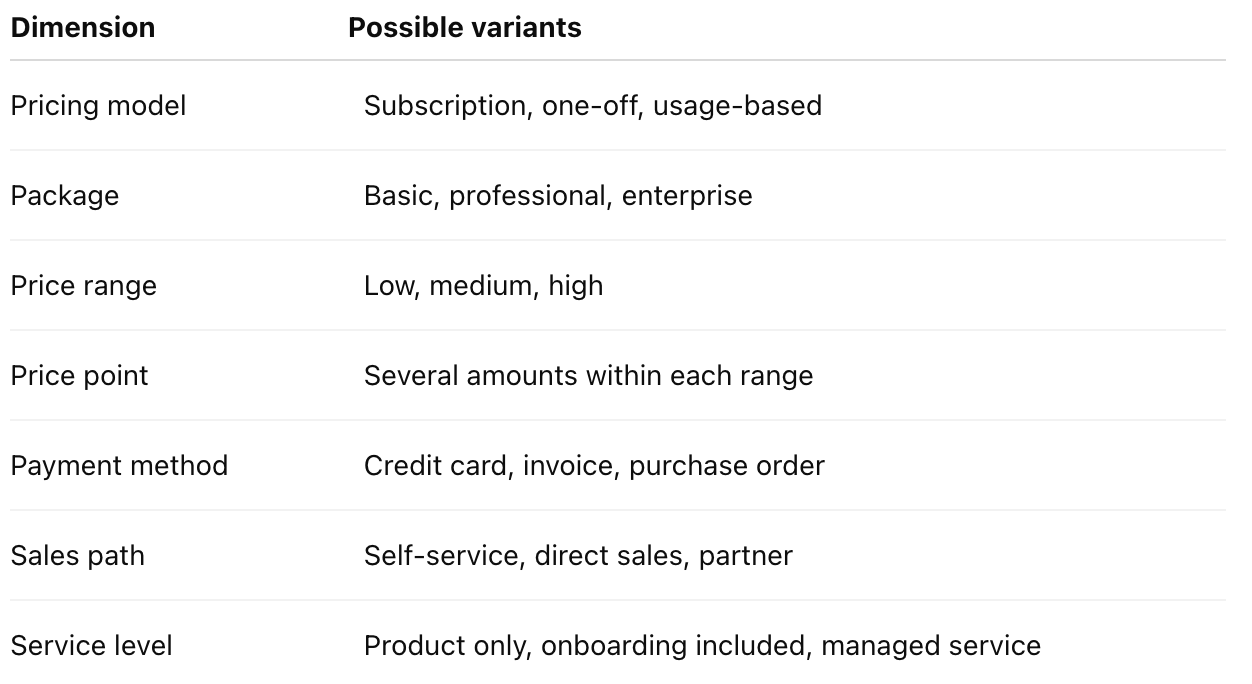
The objective is not to expose every customer to every possible combination. Different versions can be investigated with different customer groups through conversations, mock-ups, quotations, pilot offers, or real transactions.
This produces more useful evidence than testing one price in isolation because the company can begin to see which combinations work for particular customers and under which conditions.
It may discover that a subscription works for smaller customers, while enterprise clients prefer a license combined with implementation fees. It may learn that customers accept a higher price when onboarding is included, or that an apparently attractive low-cost plan generates so much support demand that it destroys the margin.
The preferred combination is not necessarily the one that produces the highest conversion.
High conversion is irrelevant if acquisition, onboarding, support, and retention costs make every additional customer economically destructive.
The relevant question is whether the configuration creates sufficient value for customers while allowing the company to acquire, serve, and retain them sustainably.
Launch is not the end of learning
Even the strongest pre-launch experiments remain incomplete. Once a product enters the wider market, the company receives behavioral data that were unavailable before.
This does not mean the earlier work was unnecessary. It means learning continues with stronger evidence and higher stakes.
Customers buy or decline. They renew or leave. They expand their usage or remain on the smallest plan. Sales cycles become visible. Support demand becomes measurable. Acquisition and delivery costs become clearer. Competitors respond, expectations change, and the value of the offering evolves.
The business model must continue learning alongside the product.
That is why I see pricing as part of Continuous Business Model Innovation rather than as a decision that is made once and then implemented.
Existing customers may not need to pay the same price as new customers. Early adopters accepted a less mature product and often contributed feedback, patience, credibility, and learning. New customers may receive a broader, more reliable, and more valuable offering.
Likewise, not every customer segment needs to see the same packages, payment terms, or pricing model. Different customers may have different jobs, procurement constraints, service requirements, alternatives, and cost-to-serve profiles.
Business model experimentation should therefore not stop once an initial model has been selected. Research into Lean Startup and business model experimentation similarly emphasizes iterative learning, continued stakeholder engagement, and the possibility that new business model configurations emerge through the experimentation process itself.¹ ²
The market will keep producing new evidence.
The responsibility of the company is to keep using it.
The real decision
Looking back, I would now phrase my original claim more carefully.
Not every element of a business model can be fully validated before launch. However, every critical element can be made explicit, investigated, exposed to possible falsification, and supported by progressively stronger evidence before the company commits at scale.
Pricing is not an exception to this principle. It may be one of its most consequential applications.
The economic model determines whether the company can create enough value for customers and retain enough of that value to become financially viable. It influences whether the venture can reach break-even, continue operating, and attract further capital, knowledge, employees, partners, and ecosystem support.
A mistake in this area is not a minor pricing error. It can become a bet on an entire system of sales, delivery, support, and financing that cannot sustain itself.
That bet is too expensive to place solely on confidence, convention, competitor comparisons, or somebody’s best guess.
The purpose of experimentation is not to prevent every mistake. It is to expose more of the unknowns, reduce avoidable uncertainty, and make the inevitable market learning less destructive.
Launch should not be the first time the economic logic encounters reality.
It should be the moment a partially tested business model begins its next, more demanding round of continuous falsification and learning.
Paid application section
Apply it to your decision
Understanding that pricing is an interconnected system of assumptions is useful. The more demanding task is applying that understanding to a real business model decision.
The following process helps you identify the economic assumption carrying the greatest risk, define what would falsify it, and decide what evidence you require before increasing the commitment.
