


If you’ve led teams for any length of time, you’ve seen the same movie.
A transformation program launches.
Bold promises. Weekly KPIs. A new platform rolled out with banners and town halls.
For a few quarters, the dashboards glow.
Engagement surveys tick up.
Leaders celebrate momentum.
And then, slowly, everything snaps back.
The old habits return.
The operating rhythm resets.
The “transformation” dissolves into business as usual.
Not because people resist change.
But because most transformations begin at the wrong end — with results instead of identity.
You cannot performance-manage your way into a different future.
You have to decide who you want to become.
Only then can habits shift.
Only then can outcomes follow.
Anything less is theatre.
The Three Layers of Behavior Change
Transformation is not a sequence of tasks. It’s a stack of identity, habits, and outcomes — and they move in only one direction: inside-out.
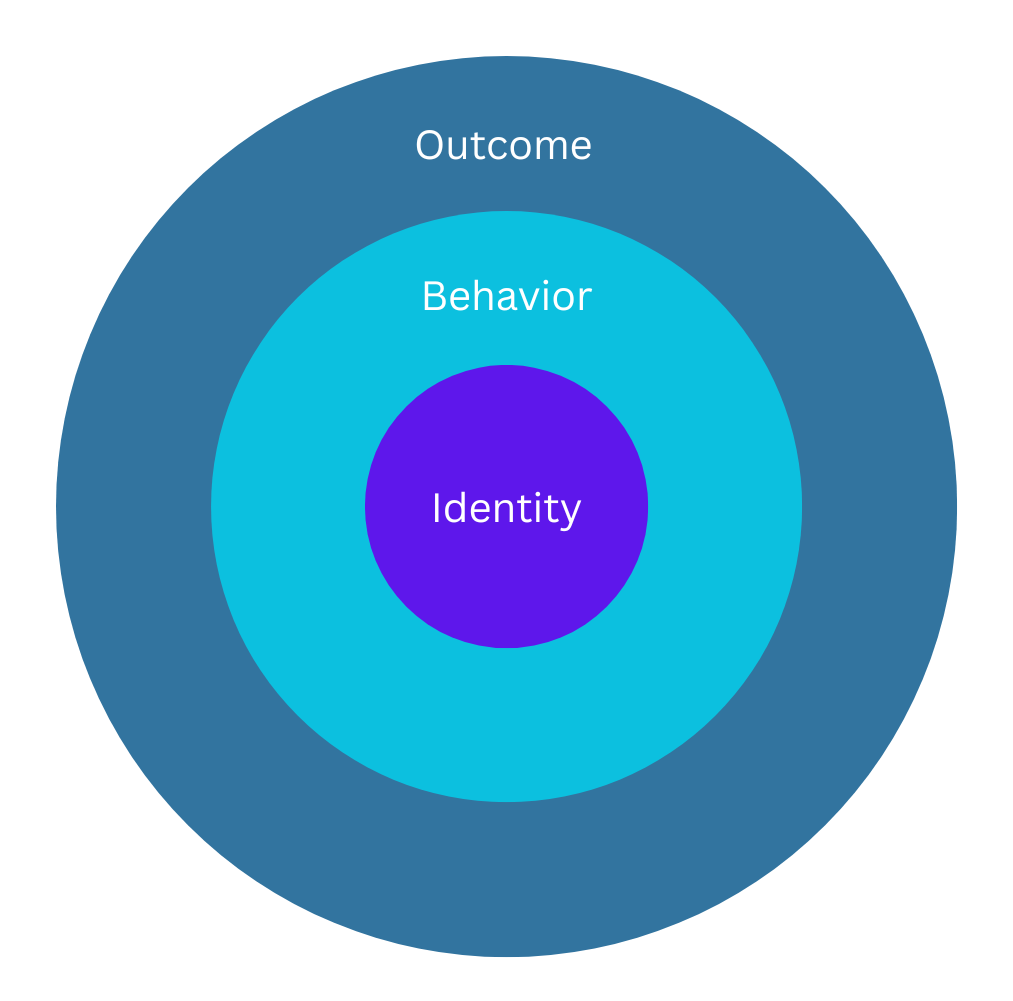
1. Outcomes — What You Get
Revenue, market share, cost efficiency, productivity, NPS.
Leaders track these obsessively because they’re visible and comforting.
But outcomes are lagging signals. They tell you what the system produced, not how it works.
Managing outcomes without redesigning the system creates the illusion of progress.
2. Habits — What You Do
Habits are the internal operating system:
how you decide, escalate, collaborate, reward, and resolve conflict.
Strategy lives or dies in this layer.
If habits contradict your stated identity, habits win.
3. Identity — Who You Are (or Intend to Become)
Identity defines what feels normal, acceptable, and possible inside your company.
It is the collective belief about your role in the market and how you create value.
This hierarchy is not negotiable:
Change identity → habits adjust → outcomes follow
Change outcomes only → habits resist → identity freezes
Two Directions of Transformation: Outside-In vs. Inside-Out
There are only two ways organizations transform:
let the market shape your identity (Outside-In), or
let identity shape your response to the market (Inside-Out).
Both paths are valid. Both paths fail when applied at the wrong stage.
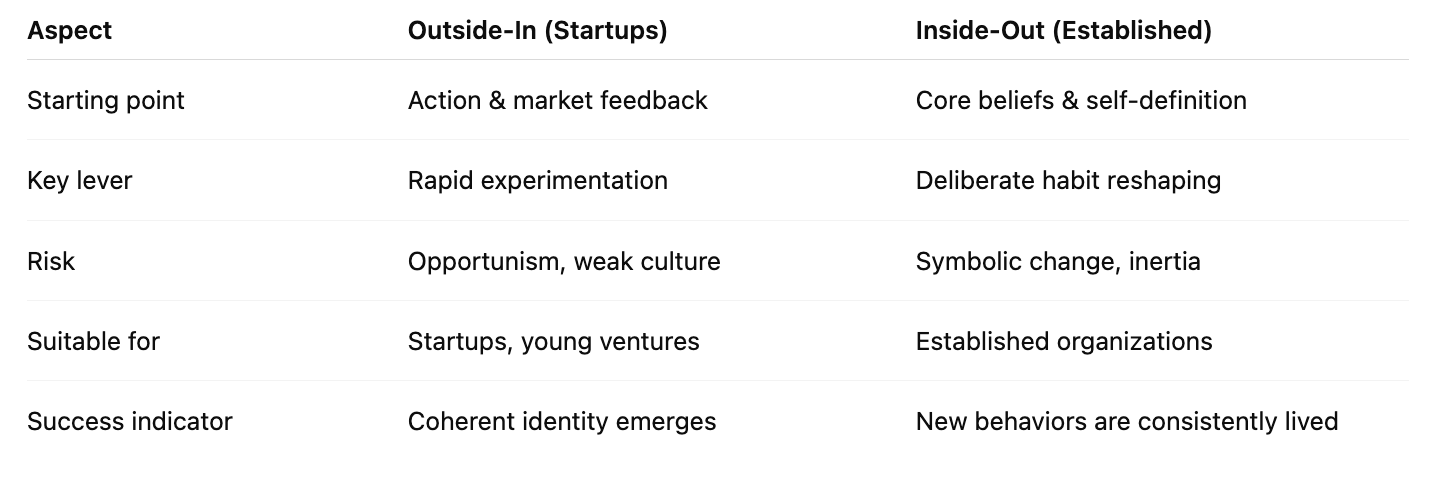
1. Outside-In: The Startup Mode
Identity emerges through action, not intention.
How It Works
Startups ship experiments, test value propositions, and react to real customer feedback. Through cycles of randomness and discovery, patterns appear — and identity takes shape.
Why It Works Early On
speed matters more than alignment
the market reveals truth faster than internal workshops
identity emerges from what actually works
Risks
chasing signals instead of direction
identity remains fluid too long
culture depends on founder energy, not shared beliefs
Identity Inflection Point
By 50–100 people, the company must shift.
Outside-In cannot scale.
Identity must solidify or the company drifts.
Example
Early-stage SaaS companies pivot repeatedly until something sticks.
Only then does culture begin to form — and habits stabilize.
2. Inside-Out: Established Companies
How it Works
Organizations already have a well-formed identity. Often, that identity no longer aligns with reality. Inside-Out transformation begins by redefining core beliefs and intentionally shaping habits to reflect them.
Why It Works for Mature Companies
deeply held norms require intentional unlearning
internal coherence matters more than raw speed
identity creates alignment across thousands of employees
Risks
symbolic change with no behavioral shift
mid-level inertia maintaining the old operating system
identity misaligned with market reality
Example
Microsoft under Satya Nadella didn’t start with cloud metrics.
It started with growth mindset — a new identity — which reshaped collaboration, talent, and product direction.
Identity didn’t follow strategy.
Identity enabled strategy.
Strategic Differences Side by Side
When Outside-In Must Become Inside-Out
Every scaling company reaches the moment where growth accelerates faster than identity.
This is the point where companies either:
mature into coherence, or
drown in competing priorities.
Growth exposes how much identity is missing.
Examples
Amazon
Started Outside-In — experiments, categories, infrastructure.
Then moved Inside-Out: customer obsession became identity and operating discipline.
Patagonia
Pure Inside-Out from day one.
Identity defined supply chain, pricing, campaigns, and hiring.
Kodak
Inside-Out but misaligned.
Identity stayed tied to film long after customers moved on.
Identity is not a brand.
Identity is a constraint on action.
Four Leadership Questions to Diagnose Your Direction
Ask your executive team:
Are we trying to improve performance or become something else?
Is identity clear and lived, or simply documented?
Do our habits match the identity we claim?
Are we starting change based on market truth or self-definition?
Where answers split, transformation stalls.
The Leadership Challenge
Transformation is not a communications exercise.
It is operational.
Leaders must be willing to:
let go of strong performers who contradict future identity
sunset profitable businesses that no longer fit
shift decision rights away from legacy centers
reward behaviors that belong to the future, not the past
Without these moves, transformation stays symbolic.
Identity is leverage.
Identity shifts create habit shifts.
Habit shifts create measurable outcomes.
Anything else is rebranding.
Why Identity is the Ultimate Leverage
Most transformation frameworks (OKRs, agile, Lean, portfolio systems) are neutral.
They inherit the identity of the system using them.
Identity is the hidden engine:
It determines which trade-offs feel acceptable
It shapes what leaders reward
It sets the boundaries of imagination
It influences which risks feel “responsible”
Enduring Companies
Tesla, Patagonia, Amazon — they align every action with identity.
Fading Companies
Blockbuster, Nokia, Kodak — they defended an outdated identity while chasing new metrics.
Identity is both lens and engine.
Change it, and everything else becomes possible.
Ignore it, and transformation becomes a well-documented failure.
Inspiring Takeaways
Transformation isn’t a KPI exercise — it’s a self-definition exercise.
Habits are the bridge; identity is the foundation.
Outside-In is fast; Inside-Out is enduring.
The strongest companies blend both: act fast, but define who you want to become before habits harden.
Leaders must make operational choices, not symbolic declarations.
Identity is where transformation starts.
Identity is where it ends when the work is avoided.

If your transformation feels slow, cosmetic, or stuck, let’s work through the identity and system behind it.
Book a session — and design a future you can actually grow into.