


LEGO is usually presented as one big turnaround: the company diversified too far, returned to the brick and recovered.
That interpretation ends too early.
LEGO did not restore one business model and then leave it unchanged. It repeatedly adapted the elements around a stable System in Play.
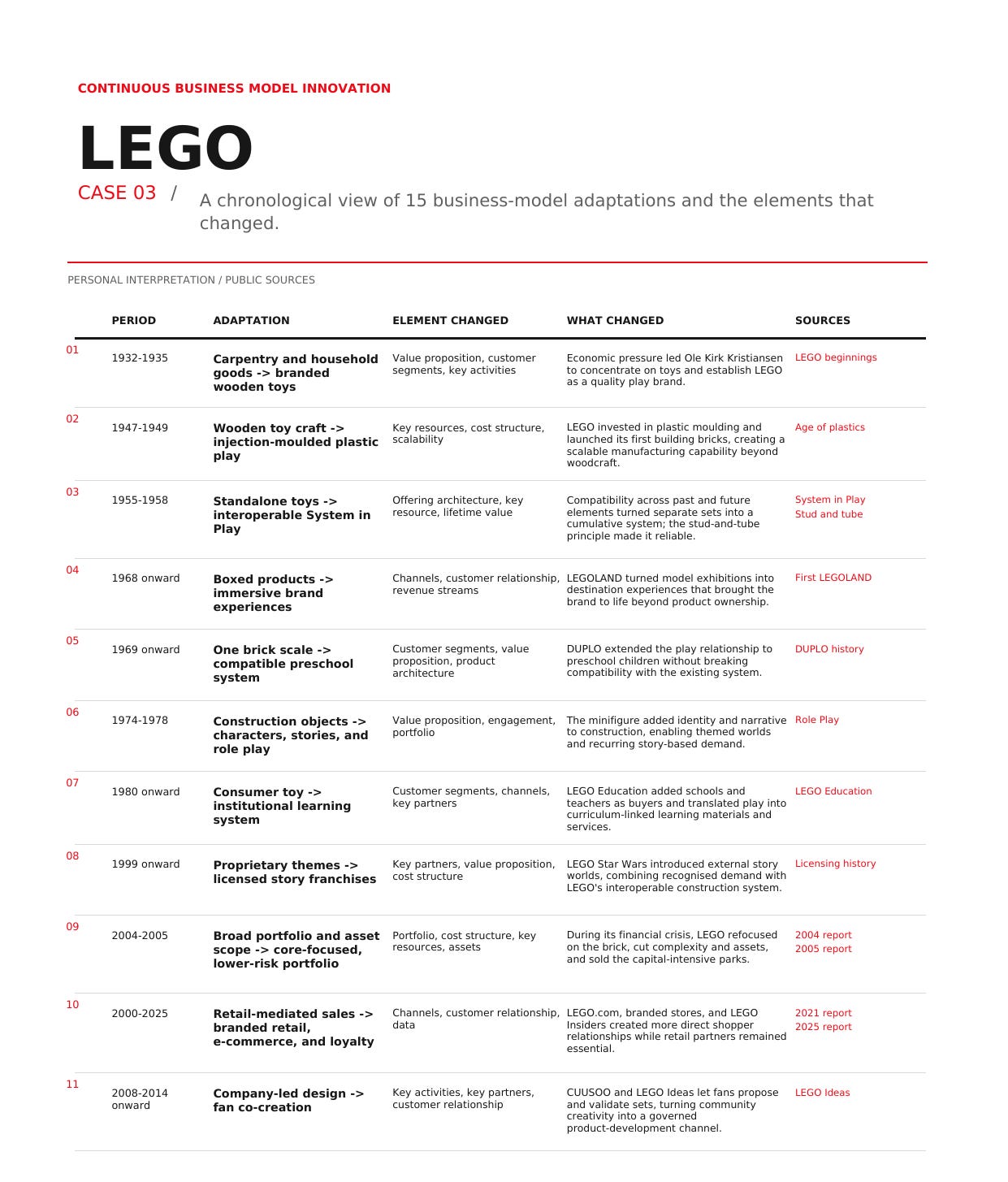
Wooden toys established the play business. Plastic molding created scale. The System in Play made purchases cumulative. DUPLO extended the age range without breaking compatibility. The minifigure added stories and role play. LEGOLAND turned products into experiences. Education introduced schools as customers. Star Wars brought licensed stories into the system.
The 2004 crisis forced LEGO to reduce complexity, sell assets and reconsider which capabilities belonged inside the company. Branded retail and e-commerce deepened customer relationships. LEGO Ideas added fan co-creation. NINJAGO created a home-grown transmedia world. Adult products broadened the audience. LEGO Fortnite connected physical and digital play. The 2026 acquisition of the Discovery Centres selectively brought experiences back under direct ownership.
Each adaptation expanded what the LEGO system could do. Each also added new complexity that the company had to govern.
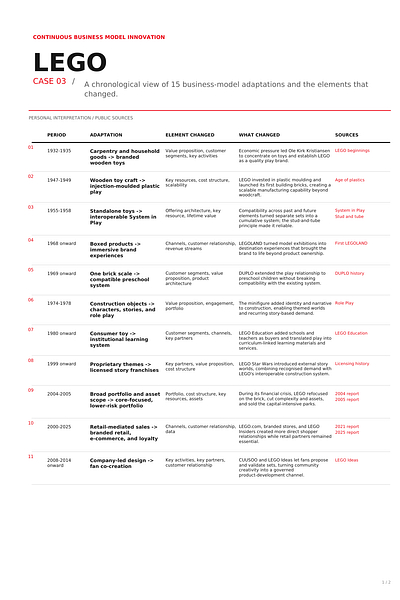
The familiar story ends too early
The familiar LEGO story centres on the financial crisis of 2003 and 2004. The company had expanded its portfolio, activities and asset base while facing declining demand for traditional toys, stronger price competition, retail consolidation and competition from consumer electronics.
LEGO’s 2004 Annual Report described a fundamental change in direction. The company would concentrate again on its classic core products, reduce its cost base and lower its exposure. The following year, it sold the LEGOLAND parks because they did not directly fit the core business as then defined.
Returning to the brick was consequential. But it did not complete the adaptation.
If recovery had meant only making fewer products around the original brick, the LEGO Group that followed would have been a smaller version of the company that entered the crisis. Instead, LEGO expanded again through licensed franchises, fan communities, owned story worlds, direct retail, adult audiences, loyalty programs, digital play and branded experiences.
The difference was not expansion versus focus. It was coherent expansion versus complexity that the business model could no longer support.
The brick remained important because it provided a stable foundation. The more consequential strategic asset was the System in Play: a commitment that elements bought at different times would continue to work together and increase one another’s usefulness.
LEGO did not win by returning to one product. It won by restoring coherence to the system around that product.
Four phases of adaptation
1. Turn separate toys into a cumulative system
LEGO began with wooden toys and other household products. By 1935, Ole Kirk Kristiansen had decided to concentrate on toys and establish a distinct brand around the idea of playing well.
The move into plastic during the late 1940s changed more than the material. Injection molding required new equipment, technical knowledge, tooling and capital. It also created a manufacturing model capable of scaling beyond the limits of woodcraft.
The decisive change came with the LEGO System in Play in 1955. Instead of treating every toy as a separate purchase, LEGO created a system in which elements acquired at different times remained compatible. The stud-and-tube principle patented in 1958 provided the stability needed to make that promise work.
Compatibility changed the economics of subsequent purchases. A new set did not replace the old one. It increased what the existing collection could become.
LEGO was no longer selling only individual toys. It was selling additions to an accumulating system.
2. Expand the system into new ages, jobs, stories and experiences
DUPLO extended the potential relationship to preschool children without creating a disconnected product architecture. The larger bricks remained compatible with standard LEGO elements. A new customer segment strengthened the existing system rather than fragmenting it.
The minifigure changed the job the product could perform. LEGO construction had concentrated largely on houses, vehicles and other physical structures. Characters introduced identity, narrative and role play while still fitting the same system.
LEGO Education then added schools and teachers as customers. The buyer, channel and expected outcome changed. LEGO added curriculum-linked materials, manuals and learning objectives, but the construction system remained recognizable.
LEGOLAND moved in another direction. It turned the creativity enabled by the product into a public, immersive experience. LEGO was no longer present only in the home, shop or classroom. The brand itself became a destination.
Licensed intellectual property extended the system again. LEGO Star Wars, launched in 1999, brought a recognized external story world into LEGO play. It gave LEGO access to existing demand while giving the franchise a new form of participation through construction.
These were substantially different adaptations. They changed customer segments, partners, channels, activities and value propositions. What connected them was that each could increase the reach or usefulness of the same underlying system.
3. Restore coherence and reconsider what belonged inside
The 2004 crisis forced LEGO to distinguish between extensions that reinforced the system and activities whose complexity, assets or economics it could no longer support.
The company refocused on the brick, reduced costs and risk, and sold the LEGOLAND parks. The experiences continued under Merlin Entertainments, allowing the LEGO brand to remain present without the LEGO Group operating the capital-intensive parks itself.
LEGO also tested the opposite boundary. Under its rescue plan, it outsourced a substantial share of production to Flextronics. The arrangement was intended to reduce costs. Instead, component shortages and coordination problems made it harder to respond to demand.
LEGO ended the partnership and brought production back inside. The company later described precision molding as a core competence it should not have handed over.
Selling the parks and insourcing production were not contradictory decisions. They reflected different constraints.
Park ownership increased capital exposure without being essential to the production of LEGO play. Manufacturing control affected quality, responsiveness and the integrity of the system itself.
The important question was therefore not whether LEGO should own more or own less. It was which capabilities and assets required control, and which could create value through partnership.
4. Deepen the relationship and connect physical with digital play
After restoring coherence, LEGO began expanding again without returning to the earlier logic of uncontrolled scope.
LEGO.com, branded stores and the LEGO Insiders program created more direct relationships alongside retail partners. LEGO gained greater control over presentation, access to shopper data, opportunities for exclusives and a continuing membership relationship.
LEGO Ideas extended that relationship into product development. Fans could propose concepts, attract public support and potentially see their designs become official products. LEGO retained selection and production control while using the community to supply ideas and reveal demand.
NINJAGO reduced part of the dependence on external franchises. It connected sets, television, games, films and merchandise around LEGO-owned characters and stories. What began as a product line with a planned end became an evergreen property because customers continued asking for it.
LEGO also broadened its definition of the customer. More complex, display-oriented and passion-led sets made adult fans an explicit growth segment rather than an incidental audience for a children’s product.
LEGO Fortnite moved the system into a continuously operated digital environment through the partnership with Epic Games. Physical Fortnite sets then translated characters and locations from the game back into construction products.
The movement now works in both directions. Physical play informs the digital experience. Digital participation creates demand for physical construction. Both can strengthen the wider LEGO system.
The 2026 acquisition of 29 LEGO Discovery Centres and LEGOLAND Discovery Centres changed the boundary again. LEGO brought smaller indoor experiences and their retail outlets under direct ownership, while Merlin continued focusing on the larger LEGOLAND resorts.
This was not simply a reversal of the 2005 park sale. LEGO selectively reclaimed the experiences that could deepen direct customer relationships while leaving capital-intensive destination parks with a specialist partner.
Three lessons from the case
1. The core can be an architecture rather than a product
Calling the brick LEGO’s core is understandable but incomplete. Many companies can manufacture compatible construction bricks. LEGO’s stronger core is the system around the brick: compatibility across generations, manufacturing precision, open-ended construction, recognizable design and the ability to combine building with stories and role play.
This distinction changes how leaders should evaluate adjacencies.
DUPLO changed the scale of the element. The minifigure introduced characters. Education changed the customer and outcome. Star Wars added an external story. NINJAGO created an owned story world. Fortnite added digital play.
Each moved away from the original product in some respect. Each could still reinforce the underlying architecture.
The relevant question is not simply whether a new offer resembles what the company already sells. It is whether the new offer increases the value, reach or defensibility of the system the company already possesses.
2. Expansion creates value when it compounds the system
An extension can add revenue without strengthening the business model. It may use the brand, customers or distribution while adding separate capabilities, costs and dependencies that do not reinforce what already exists.
LEGO’s strongest adaptations created cumulative effects. DUPLO extended the customer’s potential lifetime with the system. New themes increased the usefulness of existing bricks and minifigures. Fan-created sets added variety without replacing the core architecture. Digital worlds could create demand for physical sets. Direct channels strengthened customer relationships across the portfolio.
The 2004 crisis showed the other side. Growth can destroy value when the organization cannot explain how its extensions reinforce one another or support the economics needed to deliver them.
Business-model expansion should therefore be judged by more than the attractiveness of the new market. Leaders should ask what the extension makes more valuable elsewhere in the system — and which additional complexity the organization must absorb in return.
3. System value and system complexity can grow together
LEGO’s adaptations created more ways to enter and remain within the ecosystem: preschool play, role play, learning, licensed stories, fan-designed products, adult display, games, films, physical retail, memberships and branded experiences.
The same moves added products, partners, rights, platforms, data, channels, operating models and organizational dependencies.
This creates the strategic tension at the centre of the case:
Every new theme, license, audience, channel and physical-digital experience can strengthen the System in Play or recreate the complexity exposed by the 2004 crisis.
The problem is not whether LEGO should expand. It is how to distinguish extensions that reinforce the system from activities that merely borrow the brand.
The 2005 park sale, the outsourcing and insourcing of production, the Epic Games partnership and the 2026 acquisition of the Discovery Centres show that the answer can change over time.
What belongs inside the company should follow the constraint. When capital exposure threatens resilience, partnership may be valuable. When quality, learning or responsiveness depends on control, ownership may be necessary.
Continuous business-model innovation therefore includes expansion, contraction and reversals. The discipline lies in preserving coherence while the boundary of the business changes.
Future cases will examine other organizations that changed their business models as technologies, customer behavior and old assumptions became constraints. Subscribe for source-backed cases, strategic interpretation and practical decision tools.
What would you challenge?
Which LEGO adaptation most fundamentally changed the company’s business model?
I am particularly interested in interpretations that challenge the chronology, the business-model elements I assigned or the tension between extending the System in Play and recreating organizational complexity.
Use this case with your team
I am developing Continuous Business Model Innovation as a format for executive briefings, strategy off-sites, workshops, bootcamps and teaching.
The purpose is not to copy LEGO or expand into another adjacency because it worked for someone else. It is to help a team determine what must remain invariant, which part of its business model has become a constraint, where complexity is accumulating and what should be tested before committing further resources.
If your organization is facing such a decision, send me the concrete situation you are working through.
This analysis reflects my personal interpretation of the LEGO Group’s business-model adaptations based on available public data and public sources. LEGO, the LEGO logo and related marks are trademarks of the LEGO Group. This independent analysis is not affiliated with or endorsed by the LEGO Group.
Subscribe to INNOVATION&
Evidence-based analysis, practical tools and innovation strategy consulting for leaders deciding what to test, fund, pivot, stop or scale.