


Lean Startup started as a discipline for reducing uncertainty.
A way to learn what mattered before investing heavily.
A method to stay grounded in reality instead of assumptions.
But over time, it became a ritual.
Teams “build, measure, learn” — or at least believe they do.
What was once meant to slow us down just enough to think has become a sophisticated way to be wrong faster.
We made Lean quicker, not smarter.
And that is the real problem.
The Most Expensive Part of Lean Startup
If Lean is about eliminating waste, the irony is almost painful:
Building, measuring, and learning is often the most expensive part.
Writing code. Designing flows. Shipping prototypes. Launching MVPs.
These steps consume money, attention, and political capital — long before anyone knows whether the underlying problem even exists. And that’s the tragic twist: Steve Blank’s original idea was never to build faster, but to develop a customer through disciplined discovery before anything else.
Instead, most teams race to build before they understand.
They run tests before they know what’s worth testing.
They measure clicks instead of meaning.
The result?
Efficient waste. Perfectly documented. Dashboard-friendly. Strategically empty.
Lean doesn’t necessarily reduce risk. If misused, it simply multiplies it with discipline.
The Urge to Build
Why is it so hard not to act?
Because building feels like momentum.
It looks productive.
It signals decisiveness.
It produces artifacts others can see.
A prototype is comforting.
A roadmap is reassuring.
A sprint makes everyone appear aligned.
But real learning doesn’t begin with doing.
It begins with understanding.
With curiosity instead of velocity.
With silence instead of slides.
With the humility of admitting we do not know yet.
Most organizations are optimized for answers, not for questions.
The one who asks looks uncertain.
The one who builds looks confident.
So we mistake confidence for progress, and action for insight.
We respond to every problem with a solution,
instead of responding to every symptom with a question.
What’s Not Being Said
User research is often misunderstood.
People think it’s about talking.
It’s actually about listening — especially to what remains unsaid.
Customers rarely articulate what they truly need.
They describe their symptoms.
Their frustrations.
Their pain points.
Their imagined fixes.
Someone says, “I need an app that saves me time.”
What they may really mean is, “I want to stop feeling behind.”
That’s the difference between a feature and actual progress.
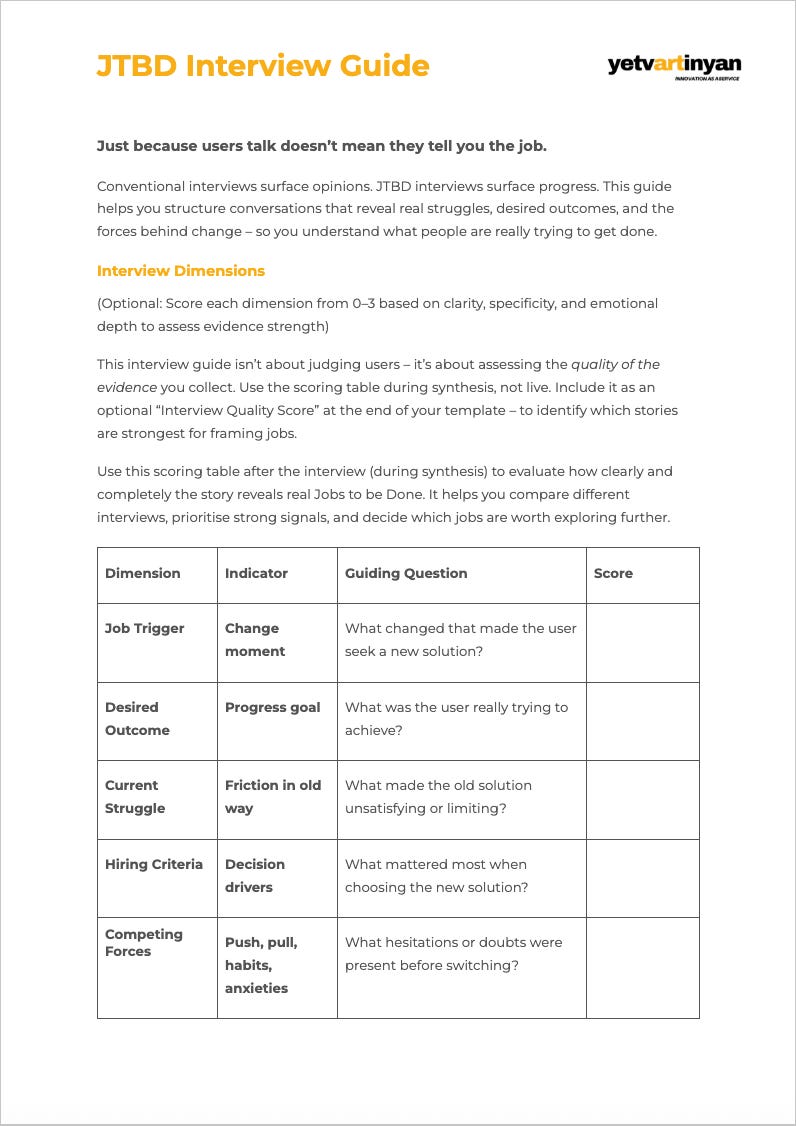
If you listen closely, you discover the real job to be done — the emotional, social, and functional progress someone is truly trying to make
🧩 Want to see the tool I use for this step?
→ Check out my JTBD Interview Guide, or grab the full Innovation Toolkit.
Learning Without Building
Here’s a question many teams never ask:
What if you could learn without building anything?
No code.
No prototype.
No MVP.
No A/B test.
You can — if you redefine what learning actually is.
Learning isn’t testing whether something works.
Learning is understanding what’s worth testing at all.
Observe before you measure.
Ask before you answer.
Map decisions before you model solutions.
Strong innovators spend more time understanding than executing — not because they’re slow, but because every misunderstanding compounds over time.
Ironically, the fastest learning is often the kind that refuses to rush.
The Illusion of Validation
Teams love saying, “We’re validating our hypotheses.”
It sounds scientific.
It rarely is.
Most teams don’t validate — they justify.
They build experiments that confirm their initial belief.
They ignore contradicting signals.
They measure what’s easy instead of what’s meaningful.
Validation becomes a performance.
Metrics become armor.
Dashboards become shields.
That’s not learning.
That’s “confirmation as a service”.
True validation requires courage.
Not the courage to ship — the courage to discover you may be wrong while it’s still cheap.
Lean was meant to strengthen that courage.
Too often, it replaced it with metrics.
We don’t learn to understand.
We measure to feel safe.
Silence as a Method
In a world obsessed with building, releasing, and iterating, silence looks like inactivity.
But silence is where insight lives.
Observation is a method.
Patience is a method.
Listening without rushing to interpret is a method.
When you stop listening to reply and start listening to notice, you see things dashboards never show.
It’s like photography.
The subject is there, but the light reveals the truth.
Watch where someone hesitates.
Where they sigh.
Where they skip a step.
Where they keep returning to the same shortcut.
Meaning hides in micro-moments, not in metrics.
Learning starts there — long before Lean kicks in.
The Discipline of Not Building
It is an act of bravery not to build.
In efficiency-driven cultures, restraint looks like failure.
But restraint is what creates the space for insight.
Not building is not inaction.
It’s focus.
It’s intentionally removing noise.
It’s choosing to understand before you commit.
It’s refusing to burn resources solving the wrong problem elegantly.
Every feature, roadmap, and sprint only makes sense once the underlying progress is clear.
Sometimes the bravest move is to ask a question you don’t yet know how to answer.
Progress starts with honesty.
And honesty starts with not knowing.
A New Sequence
Maybe Lean doesn’t need to be discarded.
Maybe it needs to be reordered.
Observe → Understand → Frame → Build → Measure → Learn
Observe before you explain.
Understand before you validate.
Frame before you scale.
Build only when the “why” is unbearably clear.
This isn’t a rejection of Lean.
It’s a return to its original intention.
Lean was never about speed.
It was about clarity.
Not failing fast —
learning early.
From Efficiency to Meaning
Lean gave us efficiency, but not always meaning.
Not every experiment produces insight.
Not every MVP reveals truth.
Not every test uncovers progress.
So the real question isn’t:
“How do we learn faster?”
The real question is:
“How do we learn better?”
Better means closer to people’s lives.
Closer to their decisions.
Closer to the frictions they quietly endure.
Closer to the progress they long for.
When you learn there, you don’t build features.
You build relevance.
Learn Before You Lean
Lean wasn’t designed to make us build more — only to build smarter.
But somewhere along the way, teams began with hypotheses without context, MVPs without meaning, and roadmaps without evidence.
We need fewer sprints and more silence.
Fewer assumptions and more observation.
Less Lean — and more Learn.
Because the purpose of Lean isn’t to fail faster.
It’s to understand earlier —
so you don’t have to fail at all.

If your teams build before they understand, you’re not learning faster — you’re burning cycles.
The fix isn’t better sprints, it’s better discovery.
I run short, focused sessions with leadership teams to:
Reveal where premature building hides inside your innovation process
Reset the way your teams learn before they commit
Install a repeatable discovery system that prevents wasted cycles
👉 Get a 30-minute diagnostic.
You’ll walk away with the 3 biggest blockers slowing your discovery — and what to change next week.
Build insight first. Ship smarter after.