



How do you find early adopters before anyone has had the opportunity to adopt?
The question sounds paradoxical, but it arises in almost every innovation project. Once you have a business idea candidate, the journey usually begins with two questions: What is the problem, and who experiences it? From there, you need to determine whether your assumptions are supported by evidence. This means reviewing what is already known, examining what previous innovators and startups have tried, and eventually deciding whom to involve in your customer discovery.
One of the books I recommend without hesitation (and financial benefit) to anyone working in innovation is Everett Rogers’ Diffusion of Innovations [1]. It explains how new ideas spread through social systems and gives us the familiar categories of innovators, early adopters, the early majority, the late majority, and laggards. Although the first edition appeared more than sixty years ago, the book remains highly relevant because people do not encounter, evaluate, and adopt something new at the same time or for the same reasons.
The difficulty begins when we take categories derived from observed adoption and use them to imagine people before adoption has occurred. Rogers helps us describe what happened. He does not give us an innovator or early-adopter persona that can reliably tell us whom to interview first.
This morning, however, I found myself thinking less about the model itself and more about how we use it in practice.
Assume that you have a business idea candidate. The journey usually begins with two questions: What is the problem, and who has it? At this point, both answers are assumptions. You may start by reviewing what is already known, what previous innovators and startups attempted, and why earlier solutions succeeded, stalled, or disappeared. You then move into user research, using whichever approach is appropriate for the uncertainty you need to reduce.
Sooner or later, someone asks whom the team should speak to first. Because time, money, and access are constrained, the answer is rarely a representative sample of everyone who might eventually use the solution. Teams are often advised to begin with innovators, early adopters, or lead users: people who are expected to experience the problem more intensely, recognize the value earlier, or tolerate an incomplete solution.
That advice sounds reasonable until we try to apply it. Imagine that you encounter someone as a possible research participant. Before you have exchanged a single word with that person, how could you know whether they are an innovator or an early adopter?
You cannot know, yet many innovation teams behave as if they can. They take a category that becomes visible through behavior over time and turn it into a persona that supposedly exists beforehand.
A descriptive model becomes a prospective persona
Rogers defines innovativeness relatively. A person, group, or other unit of adoption is classified according to how early it adopts an innovation compared with other members of a social system. The categories therefore describe relative adoption timing; they were not designed as a prospecting database for customer discovery [1].
Rogers’ reasoning moves from observed adoption to a comparison of timing and then to a category. The common practical application reverses that sequence. A team selects the category “early adopter,” imagines the kind of person who should belong to it, recruits people who resemble that construction, and then interprets their answers through the same lens. The category itself is not the problem; the problem is the reversed direction of inference.
I call this the foresight trap: taking a descriptive category from the future and using it to invent a person in the present. The team is not merely anticipating who might adopt. It is constructing an ideal customer profile before it has enough real-world evidence to know which characteristics matter.
An ICP or persona can, of course, be a useful hypothesis. The problem begins when that hypothesis silently becomes the lens through which all subsequent evidence is selected and interpreted. Once an imagined innovator or early-adopter persona exists, it influences where the team looks, whom it invites, which questions it asks, which statements it considers important, and which contradictions it dismisses as irrelevant.
The resulting process can become circular. The imagined adopter determines recruitment, recruitment determines who enters the interview, and the interview is framed around the assumed adopter. The answers are then interpreted as confirmation that the team found the person it had imagined. Real-world interchange therefore does not automatically make research outside-in. If the conversation is designed around a preexisting fantasy, the interview may simply validate what it was structured to see.
I have made the same mistake
Throughout my career, I have defined users, customers, and job performers and assigned attributes to them. Early in my career, these attributes were mainly demographic. Later, my descriptions became more sophisticated. I considered professional roles, responsibilities, organizational positions, buying centers, job-performer networks, and the relationships among users, influencers, buyers, and decision-makers.
The descriptions improved, but one problem remained: I was still using my language. I was describing who I expected to recognize, test, or adopt an innovation. I was not necessarily starting with how people described the progress they were trying to make, the circumstances in which they struggled, or what would make investing in a different approach reasonable from their perspective.
That is the lesson behind this article. A persona can become more detailed without becoming more accurate. Greater precision does not turn an assumption into evidence.
Traditional personas and ICPs are not inherently useless. Once a repeatable pattern exists, an ICP can help a company decide where its sales and marketing resources are most likely to produce a return. Earlier in discovery, however, the same construct can become dangerous if it tells the team whom it expects to find instead of helping it test who actually experiences the problem and why they might act.
Before they are adopters, they are job performers
Jobs to Be Done offers a useful change of perspective. Instead of beginning by asking who looks like an early adopter, begin with the person trying to make progress. What are they trying to get done? In which circumstances does the struggle occur? How are they managing it today, and what is unsatisfactory about the current way? What has pushed them to search for something different? What attracts them to another approach, and which habits or anxieties keep them where they are? What would they have to invest or risk by changing? Who else could enable or prevent that change?
These questions do not require us to abandon Rogers’ labels. They allow us to translate those labels from company language into the language a job performer might plausibly use.
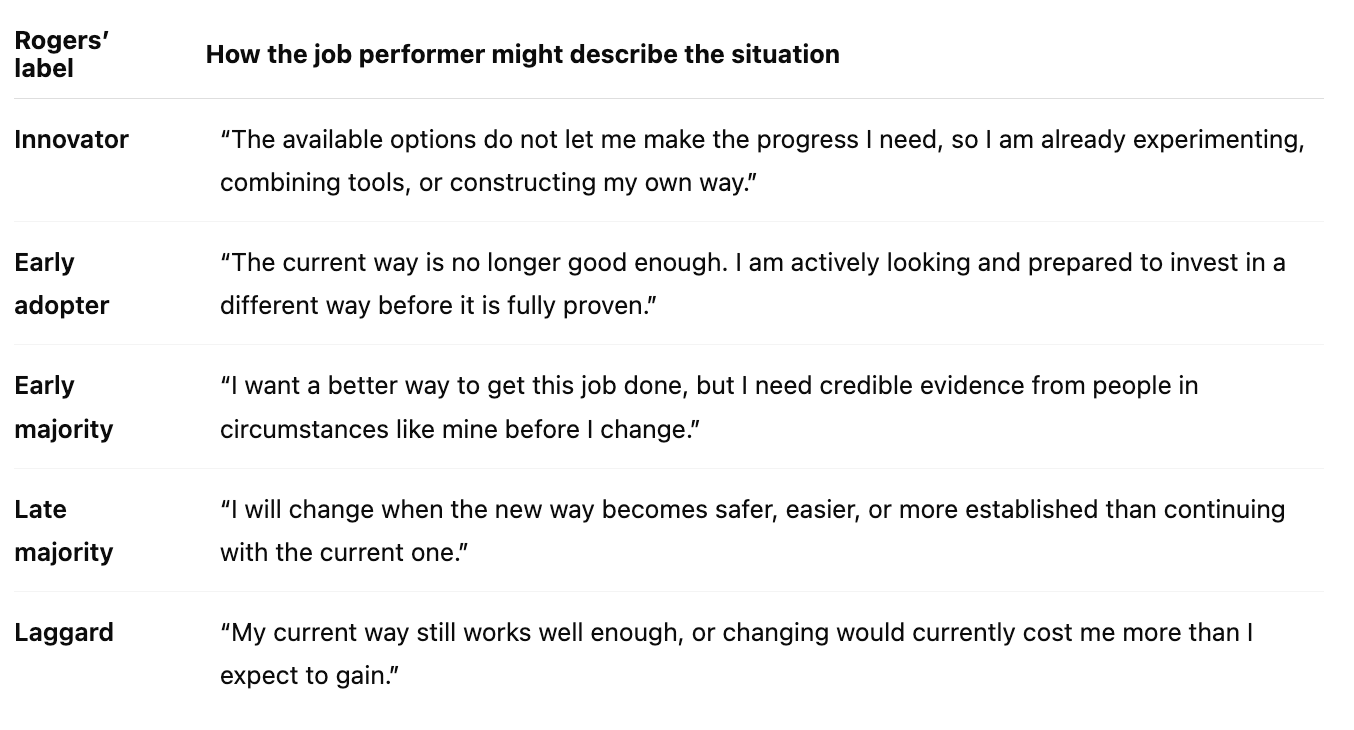
These statements are not new scientific categories, nor are they official JTBD definitions. They are translations of possible adoption logic into the perspective of someone trying to make progress. This translation also reveals why generic personal attributes are weak predictors.
The same person may experiment immediately in one area of life and wait for years in another. A software developer who tries a new coding assistant on its release day may be reluctant to change a pension product, medical treatment, or operating process. The consequences of failure, existing habits, switching costs, authority, and perceived advantage are different in each situation. Research on consumer innovativeness has similarly treated innovativeness as domain-specific rather than as one universal personal tendency [2].
The practical question is therefore not whether someone is an early adopter, but whether the circumstances surrounding a particular job make earlier engagement or adoption plausible.
Interested in working together?
The first job performers may sit outside the recognized system
“Early” only has meaning relative to a social system. Depending on the innovation, that system might be a profession, department, company, industry, household, community, or another cluster whose members influence one another.
However, the boundary of the relevant system is itself an assumption. If a company searches only inside its established market or customer base, it may miss people who still have the job but are not recognized as users. Their alternative may be an improvised workaround, a solution from another category, or simply going without.
From the perspective of such a non-user, the description might be: “I still have the job, but I perform it differently—or not adequately—because the established options are inaccessible, excessive, or unsuitable for my circumstances.”
This possibility matters particularly when exploring new-market disruption. Christensen and his coauthors describe how new-market disruptions can begin among non-consumers who did not use the previous generation of products and may therefore sit outside the value network visible to established providers [3]. If the company defines the system only through current category users, these job performers are easy to overlook.
Before searching for early adopters within a system, then, the team should ask whether it has drawn the boundary around the people who actually have the job.
Lead users, learning partners, and early adopters are not interchangeable
The people who can help a team understand an emerging problem are not necessarily the same people who will buy the first solution. Eric von Hippel defines lead users as people or organizations that experience needs ahead of the wider market and expect to benefit significantly from solving them [5]. Their experience can provide unusually rich insight into future needs, and they may already have modified existing tools or constructed their own solutions.
That does not automatically make them representative customers. A lead user may face an extreme version of the problem that the wider market will never experience. They may enjoy building their own solution and have little interest in buying yours. They may be an excellent learning partner while offering weak evidence of a scalable market.
Steve Blank’s “earlyvangelist” describes a different combination: someone who recognizes a painful problem, is actively searching, has assembled a temporary workaround, and has access to the resources required to act [6]. That profile is useful when looking for an early customer, but it should not become another fixed identity imposed before the research begins.
The distinction matters because a problem witness, a lead user, a committed learning partner, an internal champion, and a buyer can each reduce a different uncertainty. Treating all of them as “early adopters” conceals what evidence they can actually provide.
Interest, commitment, and adoption are not the same
Someone saying, “That sounds interesting,” has not adopted anything. In Rogers’ innovation-decision process, knowledge and persuasion precede the decision to adopt, while adoption involves deciding to make use of the innovation [1].
Initial interest can still matter. It may be the first signal that the problem or proposed value deserves deeper investigation. However, it is weak evidence because it costs the person almost nothing. Evidence becomes more credible as the person commits something scarce: time, data, operational access, reputation, staff capacity, or money.
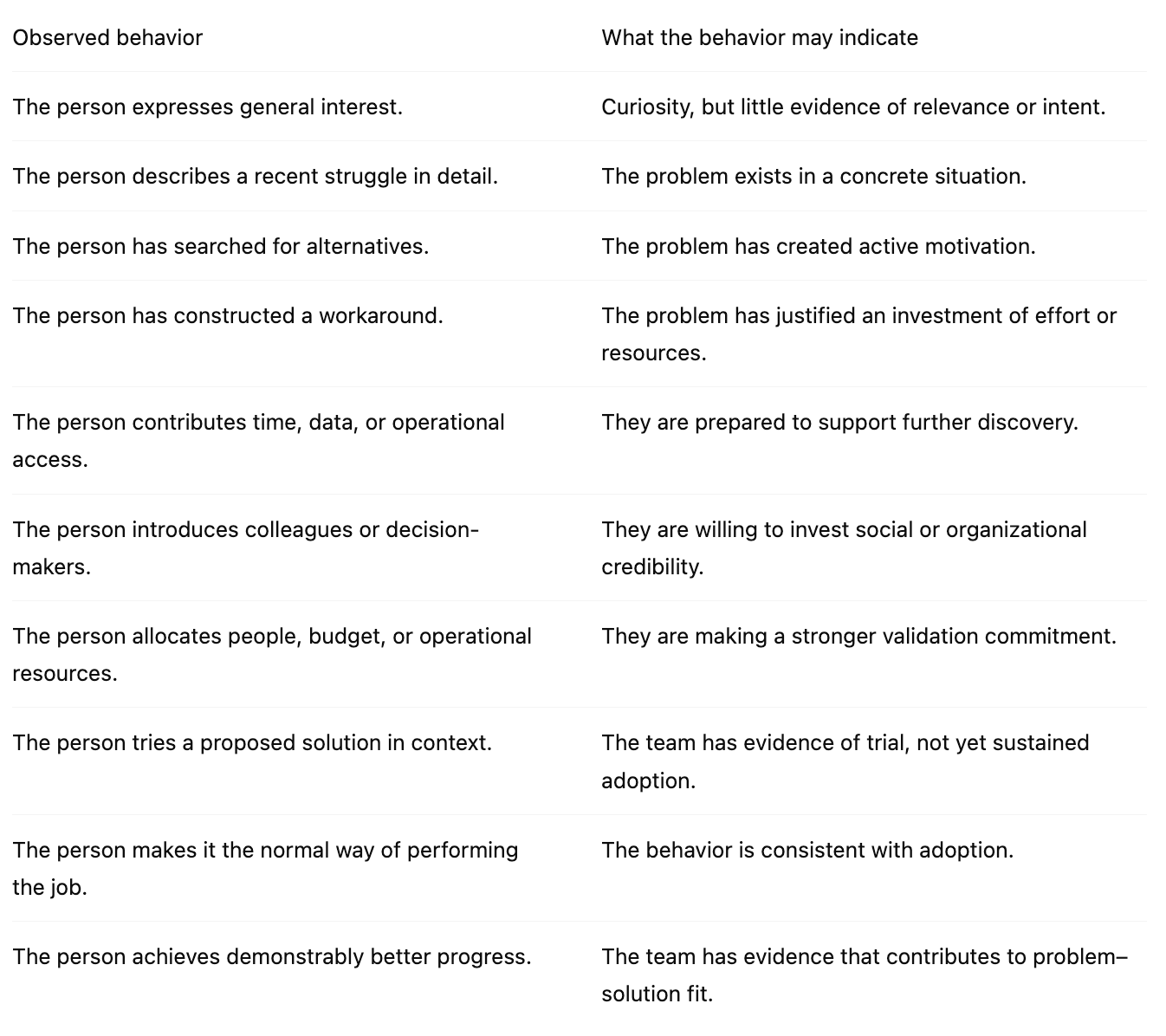
Interest is therefore only an initial signal; cost-bearing commitment provides stronger evidence, adoption comes later, and improved outcomes provide evidence of fit. If no solution exists yet, interest cannot demonstrate problem–solution fit, but it can show that a business idea candidate has earned the right to be investigated further.
That distinction matters when time and capital are constrained like in many ventures. Not everyone who might eventually benefit deserves equal attention now. People who recognize the struggle, have already tried to make progress, and are willing to invest something in further learning can reduce the next uncertainty faster.
Others may have entirely rational reasons not to invest yet. They should not automatically be dismissed as resistant or un-innovative. Some belong in a backlog until a trigger changes, stronger evidence becomes available, or the proposed solution becomes safer and easier to adopt.
Interested in working together?
There may not be one adopter
The language of “the user” can obscure another practical reality. In B2B settings, the person performing the job may not control the budget, approve a pilot, manage implementation, or bear the consequences of failure. A user, internal champion, economic buyer, technical gatekeeper, procurement function, and implementation owner may all influence whether adoption occurs.
The same is true in many consumer settings. A patient, physician, insurer, and family member can all influence a healthcare decision. A child may use a product that a parent chooses and pays for. One household member may recognize the problem while another controls the resources.
Research into organizational adoption consequently distinguishes between the organization’s decision to adopt and the subsequent acceptance and use of the innovation by individuals inside the organization [4]. The relevant unit of research is therefore not always one persona. It may be a job-performer network whose members have different jobs, incentives, anxieties, and degrees of authority. An enthusiastic user without authority can therefore be an excellent learning partner and weak evidence of organizational demand at the same time.
Before adoption, recruit for evidence
The practical conclusion is not that innovation teams should stop forming hypotheses about whom to interview. They cannot enter research without any assumptions. The conclusion is that those assumptions should describe observable situations and behaviors rather than assign an adopter identity before the relevant behavior has occurred.
Do not recruit someone merely because they resemble your imagined early adopter. Recruit job performers whose lived experience can reduce the uncertainty you face next, looking for evidence of a recent struggle, dissatisfaction with the current way, attempts to make progress, and willingness to invest time, access, credibility, or another scarce resource. Keep Rogers’ labels as descriptions of diffusion rather than turning them prematurely into identities.
Before adoption, “innovator” and “early adopter” are categories you may be projecting onto people you have not yet understood. Before they adopt, they are job performers trying to make progress in particular circumstances. Your task is not to guess which label they will eventually earn, but to understand what they are trying to get done, what prevents progress, and whether their behavior provides enough evidence to justify your next investment.
The free section of INNOVATION& is offered freely, and you are welcome to keep reading it that way. If these articles help you make better decisions in your working life, please consider becoming a paid subscriber. Researching and writing them takes time, and paid subscriptions provide the income I need to continue. Your support also helps keep part of this work available to everyone.
Thanks for reading INNOVATION&! This post is public so feel free to share it.
Start paid learning and application section
Application: The Job Performer Commitment Map
The practical decision is not simply whom to interview. It is whom to engage now, what you need to learn from them, and how much of your limited time, capital, and credibility their evidence justifies.
The Job Performer Commitment Map is designed to keep an imagined persona from becoming a self-confirming research process. It does not attempt to predict who will ultimately become an innovator or early adopter. Its purpose is narrower: to identify whose experience can reduce the next uncertainty and what observable commitment would justify the next investment.
