


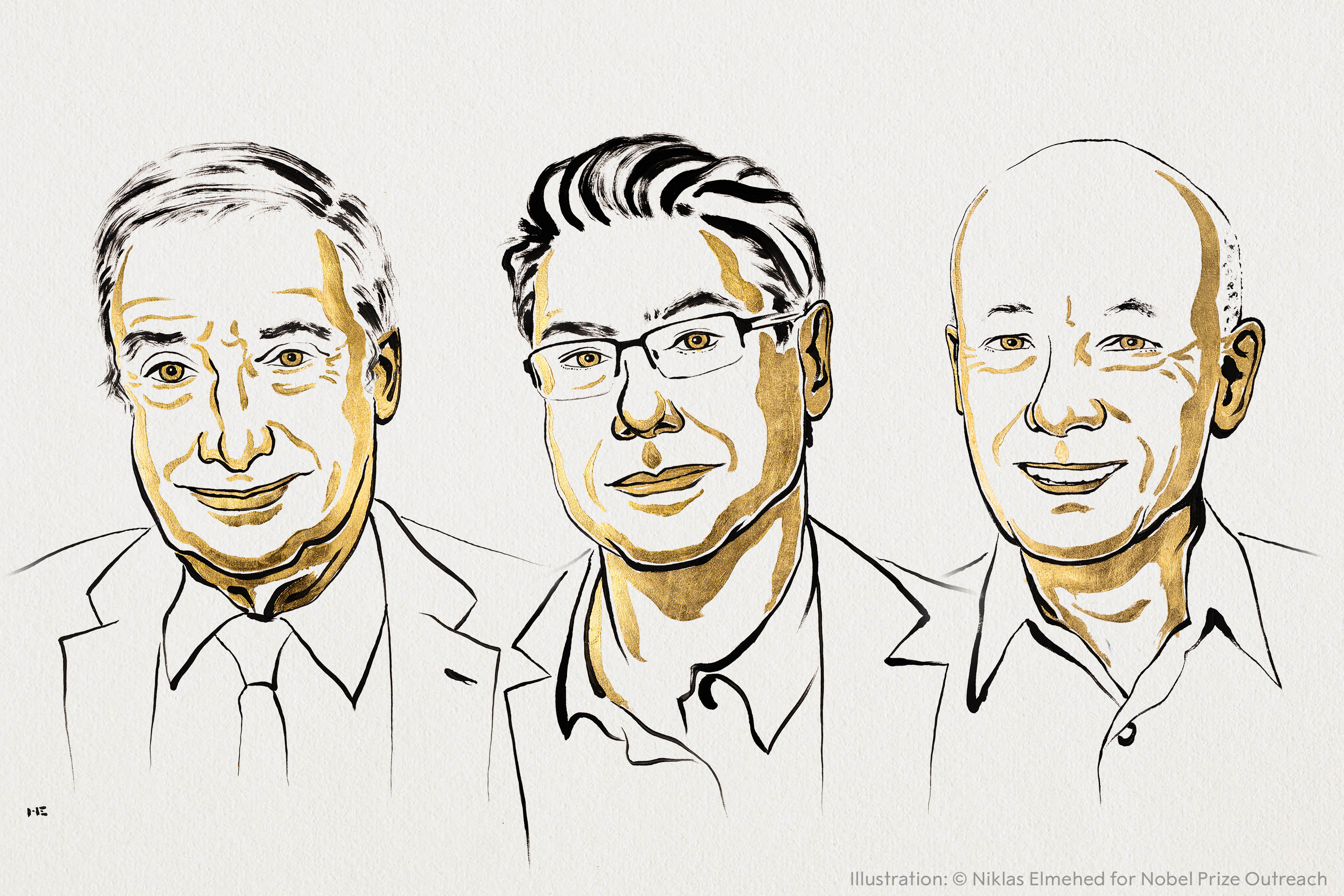
In October 2025, the Nobel Prize in Economics honored work that fundamentally deepens our understanding of innovation and economic growth. The laureates – Philippe Aghion, Peter Howitt, and Joel Mokyr – extend Joseph Schumpeter’s concept of “creative destruction,” first formulated in 1942. Schumpeter recognized that innovation is not a gentle addition of features—it is a process in which the old is destroyed so the new can thrive.
Aghion and Howitt formalized this insight. In their groundbreaking paper A Model of Growth Through Creative Destruction (1992), they developed a mathematical model explaining how technological progress and innovation generate continuous economic growth. Growth occurs through “qualitative jumps”: an innovator improves an existing product or technology, displacing the old, generating a temporary advantage—until another innovator delivers the next improvement.
Joel Mokyr complements this perspective with historical analysis. In The Lever of Riches (1990) and The Gifts of Athena (2002), he shows that technological creativity does not arise in a vacuum. Institutional conditions, knowledge diffusion, and societal structures shape how innovations emerge, spread, and drive long-term growth. Mokyr provides the context: creative destruction is embedded in a network of knowledge, policy, and culture.
Together, the laureates give us a powerful, empirically grounded framework to understand how innovation drives economic growth. Yet, while their work primarily focuses on vertical disruption—innovation that replaces existing technologies within a market—it also allows us to expand our thinking to horizontal disruption, a phenomenon increasingly relevant in today’s through technology shifts interconnected industries.
Vertical Disruption: The Classic Pattern of Creative Destruction
The Schumpeter-Aghion-Howitt model describes vertical innovation: new technology displaces an old one within a market or industry. It generates winners and losers, driving growth over time.
Newer examples illustrate this clearly, but shows also a horizontal trend:
Mobile phones → Smartphones: Nokia and other incumbents were overtaken by companies offering fundamentally better technology.
Video rental stores → Streaming services: Blockbuster collapsed as Netflix leveraged new technology and business models.
Automobiles → Electric vehicles: Tesla and others disrupt internal combustion engine dominance with superior alternatives.
Vertical innovation demonstrates the mechanics of creative destruction: incumbent companies are challenged, markets reorganize, and growth occurs as resources are reallocated to the most productive innovations. The Nobel laureates’ contributions formalize this logic: growth depends on R&D intensity, competition, and institutional conditions that enable innovation.
Key insight for executives: growth is not linear; it is punctuated, competitive, and requires continuous investment in innovation. Stand still, and you risk being overtaken.
Horizontal Disruption: Expanding the Lens
The Nobel laureates primarily analyzed vertical disruption: new technologies that replace or improve existing products within a single industry. Today, however, we are seeing a different pattern: horizontal disruption, where a single innovation simultaneously impacts multiple industries, creating entirely new dynamics across markets that were previously unrelated. Horizontal disruptions are powerful because they do not respect traditional industry boundaries—they shift value across sectors and allow new players to enter and create/shift value absorbation in areas where they were previously outsiders.
Examples of Horizontal Disruption
Artificial Intelligence (AI)
Large language models, predictive analytics, and other AI technologies are not confined to one sector—they can be applied anywhere data exists.
Finance: Automates credit scoring, fraud detection, and personalized investment advice.
Healthcare: Supports diagnostics, personalized treatment planning, and clinical research acceleration.
Manufacturing: Enables predictive maintenance, quality control, and process optimization.
Impact: Companies that originally had no presence in finance, healthcare, or manufacturing (e.g., tech giants) can now become direct competitors, demonstrating that AI creates cross-industry shifts rather than merely vertical improvements.
Cloud Computing & Platform Technologies
Cloud platforms (AWS, Azure, Google Cloud) provide scalable infrastructure to any organization, allowing them to build and scale without physical or legacy constraints.
Retail: Supports large-scale e-commerce platforms and real-time analytics.
Media: Powers streaming services and content distribution at global scale.
Automotive: Enables connected cars, fleet management, and IoT-enabled services.
Impact: Cloud technology allows companies to leap into entirely new industries without needing traditional infrastructure. A startup from outside media or automotive can compete on equal footing, demonstrating horizontal reach.
Generative AI
Generative AI produces content—text, images, music, or code—across multiple use cases simultaneously.
Marketing: Automates campaign creation and personalizes messaging.
Software Development: Generates code, tests, and documentation.
Media & Publishing: Produces news reports, summaries, and visual content.
Impact: Generative AI disrupts roles and workflows across industries at once, not sequentially, and enables entrants from unexpected sectors to compete effectively.
Apple Health
Apple leverages its ecosystem—iPhone, Apple Watch, HealthKit, and ResearchKit—to enter healthcare, an industry historically separated from consumer electronics.
Wearables collect health and activity data for diagnostics, personalized guidance, and research participation.
Partnerships with hospitals, insurers, and research institutions expand Apple’s influence into clinical and insurance workflows.
Impact: By combining hardware, software, and ecosystem leverage, Apple becomes a new competitor in healthcare, blurring the boundary between consumer technology and medical services.
Key Insight: Horizontal disruption multiplies the dynamics of creative destruction. While vertical innovation reorganizes value within a single market, horizontal technologies shift value across multiple industries, attract unexpected new players, and blur traditional industry boundaries. Leaders who understand this can anticipate threats and opportunities that span sectors, rather than focusing solely on competitors within their own industry.
Practical Implications for Executives
Horizontal disruption is not just a theoretical concern—it has profound implications for strategy, organization, and mindset.
1. Market boundaries blur:
Executives must track technologies that might disrupt adjacent or seemingly unrelated industries. Today’s “non-competitor” could be tomorrow’s market leader.
2. Early anticipation is critical:
Emerging horizontal technologies—AI, cloud, generative AI—require proactive monitoring and strategic experimentation.
3. Collaboration and competition coexist:
Horizontal technologies can create partnerships but also unexpected competition. Managing both requires agility.
4. Build tech literacy and capability:
Organizations must integrate horizontal technologies quickly to stay relevant. Skills, culture, and infrastructure are key.
5. Mindset and organizational reflection:
Stay humble: innovation follows its own logic, often faster than our strategies.
Accept that creative destruction is ongoing, cross-industry, and partially unpredictable.
Encourage learning, experimentation, and psychological safety: teams must propose disruptive ideas without fear.
Bringing it Together: Vertical Meets Horizontal
We stand on the shoulders of giants. The Nobel laureates teach us:
Growth is driven by innovation.
Creative destruction generates winners and losers.
Competition, investment, and institutional frameworks are critical.
Horizontal innovation extends these principles:
Industry boundaries dissolve.
New players emerge from unexpected sectors.
Organizations must think beyond their traditional market definitions.
A humble reflection: Our role as executives is not to control the storm of innovation but to navigate it wisely. The principles of creative destruction remain valid, but the scope has widened. We must prepare for innovation that is both vertical and horizontal, shaping industries in ways that defy historical precedents.
Actionable Steps for Leadership
Map potential horizontal disruptions: Identify technologies that could impact multiple sectors.
Assess organizational readiness: Can your teams adapt, experiment, and pivot?
Develop flexible business models: Ensure agility to respond to cross-industry shifts.
Foster culture and skills: Enable intrapreneurial thinking with psychological/financial safety and technical capability for horizontal disruption.
Leverage partnerships strategically: Collaborate with new entrants while monitoring emerging competitors.

Horizontal disruption is not a threat—it is an opportunity to shape the future proactively. Organizations that understand creative destruction and anticipate horizontal technologies are better positioned to remain relevant across industries.
I offer a keynote for executive teams to stimulate:
How horizontal technologies could impact your industry
Where new entrants and cross-industry competitors may appear
How to align your business model and organization to respond flexibly
Wow, the part about Aghion and Howitt's math model of creative destruction really stood out to me. It's so true how innovation creates those 'qualitative jumps'! I see it all the time with how fast AI tech evolvs. Older methods just get replaced. Such a brilliant piece!