
Decision Memo: AI Is Not a Productivity Tool. It Is a Strategy Test.

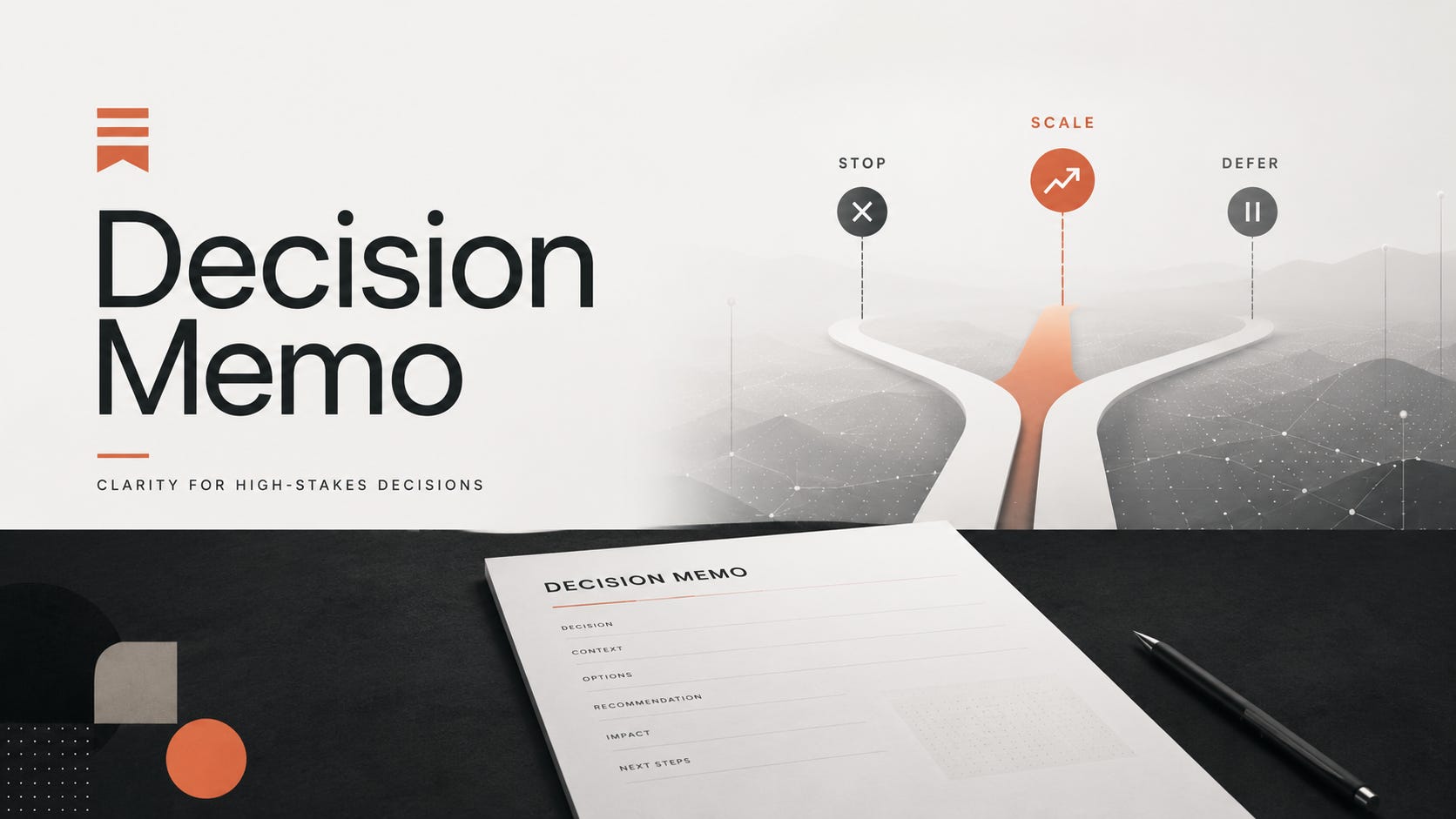
Tuesday’s article made the case that AI is not mainly a productivity tool. It is a strategy test: it shows whether a company can distinguish useful acceleration from deeper strategic exposure.
The productivity signal is too small
The easiest AI story is the productivity story. It is visible, measurable, and politically convenient. A function saves time. A team produces documents faster. A support process handles work with less effort. A board sees adoption numbers and feels the company is moving.
The harder question is whether anything important has changed.
The false signal is AI usage. The real signal is whether AI changes the logic of work, value creation, decision-making, or customer relevance. A company can become faster without becoming strategically stronger. It can reduce friction inside an operating model that should be redesigned. It can modernize the surface while protecting the assumptions that need to be tested.
That is the decision created by the article. Leaders should not ask only where AI can improve productivity. They need to decide which AI investments strengthen the current strategy, which expose weaknesses in that strategy, and which merely delay a necessary shift.
The AI Strategy Test
Use this before approving, extending, or scaling AI-related funding, especially when the proposal is justified mainly by efficiency, automation, task reduction, or adoption metrics.
The decision is not whether AI creates productivity gains. It does.
At the individual level, the evidence is already clear enough. People use AI to draft, summarize, search, code, analyze, and prepare. In specific tasks, the gains can be real. But leadership does not allocate capital to task-level excitement. It allocates capital to strategic outcomes.
The decision is not whether AI makes work faster. The decision is whether the faster work still matters.
That distinction changes the conversation. A productivity gain inside the wrong workflow is not a strategic gain. A cost reduction inside a weakening business model is not renewal. A tool that helps employees produce the same artifacts with less effort may be useful, but it should not be confused with transformation.
The central leadership question is this:
Does this AI investment improve the current model, expose the limits of the current model, or protect the current model from being questioned?
Those are three different decisions. They should not be funded through the same gate.
