
Every company says they care about their customers.
But what they usually mean is: they care about getting new ones.
Behind the scenes, budgets, incentives, and dashboards are built for one thing—acquisition. It’s legible. Easy to justify. Satisfies the board. Looks great on slides.
You can have record-breaking growth and still be quietly killing your business.
Because when companies obsess over growth, they often end up doing more of the wrong thing. More ads. More salespeople. More onboarding flows. All while the people who already trusted them are left to figure things out alone.
Churn numbers become background noise.
“It’s a little higher this quarter.”
“We had some turbulence.”
But churn isn’t weather. It’s a warning.
And it rarely starts with a bang. It starts with silence.
Silent Churn Is Your Real Competitor
People don’t leave because of a dramatic failure. They leave slowly.
They stop logging in.
Ignore your emails.
Stop mentioning you.
Switch tabs instead of tabs open.
Then one day, they’re gone.
Not because your product broke. But because someone else made them feel smarter, safer, or more valued. And you never noticed.
This is silent churn—and it’s your blind spot.
Because it doesn’t show up in postmortems. It doesn't yell. It just walks away.
Most teams don’t even track it. Because it doesn’t fit neatly into a spreadsheet or pitch deck. But it’s bleeding you every single day.
Growth Theater vs. Real Growth
Most companies are addicted to what looks like growth.
The symptoms:
Performance marketing outpaces customer success 10:1.
Product roadmaps favor shiny features for new users, not depth for loyal ones.
The company celebrates logos, not longevity.
You know your CAC by heart, but couldn’t draw your retention curve past 3 months.
That’s not strategy. That’s growth theater.
It creates the illusion of progress while hiding decay. It prioritises optics over outcomes. And it’s incredibly expensive.
Every euro spent chasing new users leaks value when the ones you already have are slowly leaving.
You’re sprinting just to stand still.
Retention Isn’t a Metric. It’s a Strategy.
Retention is usually treated as a lagging metric. But it's actually a strategic orientation.
And it compounds. Quietly. Powerfully.
Here’s what a single percentage point improvement in retention can do:
Increase Net Promoter Score (NPS)
Preserve your gross margin
Reduce acquisition dependency
Increase upsell probability
Improve forecasting accuracy
Decrease overall CAC payback
It’s one of the few moves in business that gets stronger over time.
And yet—most companies underinvest. Because retention isn’t sexy. It doesn’t spike graphs. It’s hard to attribute. And above all: it forces you to deal with uncomfortable truths.
Stuck with this topic and need hands-on help?

Metrics You're Not Tracking (But Should Be)
If you're serious about retention, you need to measure what actually matters—not just what’s easy.
Here’s what most dashboards don’t include:
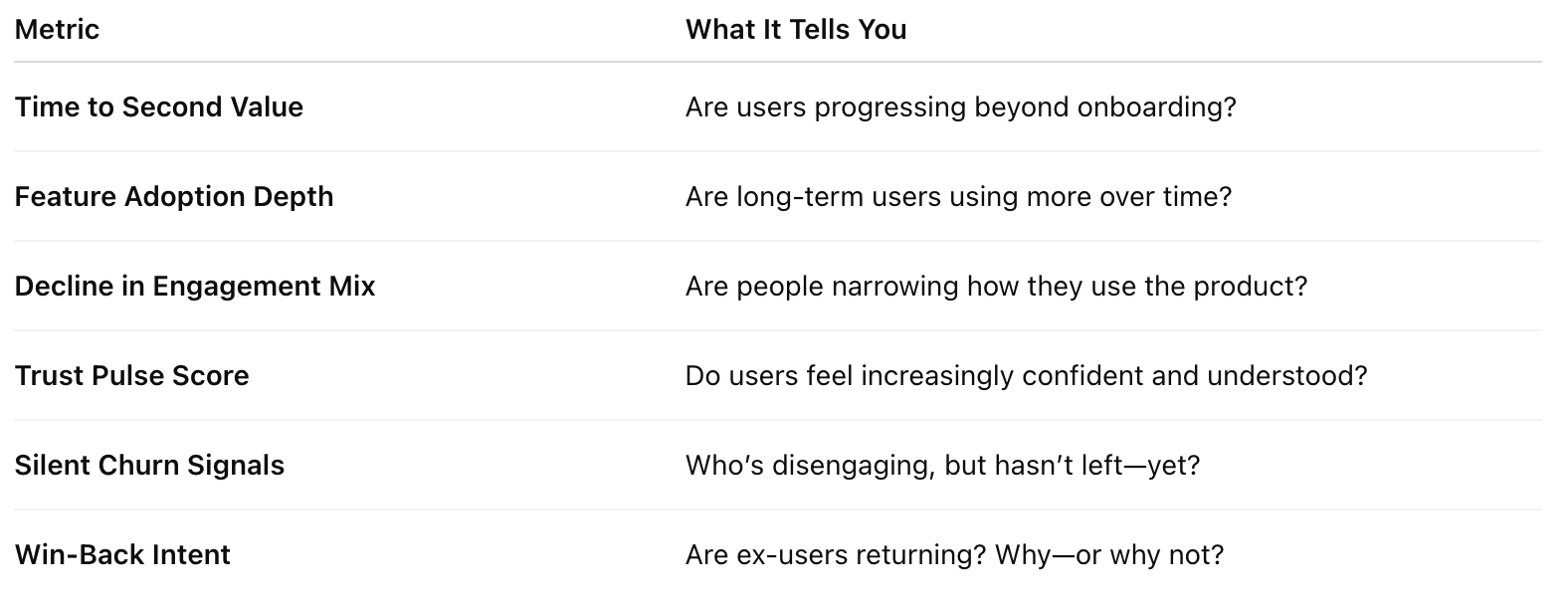
Quick Gut Check: Are You Building for Growth—or for Trust?
Run this test. Score yourself mentally. Be honest.
You spend more on performance marketing than on customer success.
Your roadmap is driven by new-user feedback, not long-term users.
You rarely (if ever) talk to churned users.
You celebrate new logos more than expanded usage or deeper engagement.
You know CAC, but not your retention cohort curves.
If three or more are true, you're likely stuck in a cycle of growth dependence, not growth resilience.
And it will only get more expensive from here.
What a Retention-First Business Looks Like
Companies that lead with retention operate differently:
Churn is a product and leadership problem, not a support one.
Their best people aren’t just closers—they’re relationship builders.
They track affection, confidence, and intent, not just clicks.
They design trust loops, not just funnels.
Their roadmap includes emotional friction, not just usability friction.
They grow slower—but don’t need to run faster just to survive.
Their real flex?
Keeping people who already trusted them. And giving them more reasons to stay.
The Antagonist: The Illusion of Predictable Growth
Let’s be clear. The enemy here isn’t just churn.
It’s the illusion that predictable growth will continue if you just spend more.
But the game has changed:
Acquisition costs are up 3–5x in most B2B and consumer categories.
Privacy changes have made targeting noisier and less effective.
Users are savvier, switching faster, trusting slower.
You can’t outspend erosion.
You have to out-trust it.
The Real Growth Lever: Relevance and Re-earning
Your next 10% MRR increase may not come from a new market.
It may already be logged in, feeling neglected.
Because here’s the thing: every renewal is not just a transaction. It’s a test of continued relevance. A moment where the user asks: Does this still do the job I need?
If the answer is “not really,” you’ve already lost.
What To Do Instead
Forget the playbooks. Start with attention.
Talk to your top 20 users this month. Ask what they value now. Not 6 months ago.
Map out emotional friction. Where do users feel dumb, lost, or ignored?
Instrument “feel nothing” signals. Drop-off in activity? Drop in diversity of feature use? Silence is data.
Run a “Trust Sprint.” One week. One team. Goal: ship 1 thing that makes loyal users feel seen.
You don’t need a full retention strategy to start re-earning trust.
You just need to stop assuming you’ve already earned it.
Final Thought: Build Quiet Power
Growth is loud.
Retention is quiet.
But only one of them compounds.
If your company’s loudness isn’t matched by deepening trust, you’re not building a business. You’re just financing one.
Start listening to the silence. It’s where the real story is hiding.