



Personal note: This is my second free article this week, a little Christmas present for you my dear reader.
Everyone talks about alignment. Boards demand it, executives preach it, consultants promise it. It sits in strategy decks like a holy grail: “We need better alignment across the organization.” And yet, when you ask leaders what alignment actually is, the answers are slippery. Some speak of shared goals. Others mean smooth operations. Some mean cultural cohesion. Often, no one can describe how to measure it, let alone improve it.
In innovation and transformation, this vagueness is dangerous. Misalignment doesn’t just slow execution; it kills opportunity. Teams chase conflicting priorities, decisions contradict each other, and experiments fail to propagate learning. But alignment, when understood and applied properly, becomes a superpower.
This article explores alignment from a deep, reflective lens and introduces a practical framework leaders can use to understand, measure, and cultivate it in their organizations—without stifling the autonomy and creativity that innovation demands.
Why Alignment Is So Hard to Define
At its simplest, alignment is the degree to which people, processes, and goals are pulling in the same direction. But that simplicity masks complexity:
Alignment is multidimensional.
Strategic: Are teams working toward the same overarching objectives?
Operational: Are workflows, decisions, and projects coordinated?
Cultural: Do values, norms, and behaviors support the shared purpose?
Individual: Does every employee understand how their work contributes to broader goals?
Alignment is dynamic, not static.
In transformation and innovation, goals shift as learning unfolds. What was aligned yesterday may diverge tomorrow. Alignment isn’t a checkbox; it’s a living process.Alignment exists in tension with autonomy.
Innovation thrives on experimentation, risk-taking, and exploration. Too much alignment can become control, stifling the very creativity it’s meant to enable. The real challenge is creating a shared direction while preserving individual freedom.
The Cost of Misalignment
Leaders underestimate the impact of misalignment because it rarely manifests as an immediate crisis. Instead, it shows up subtly:
Projects stall or duplicate effort.
Teams make decisions that conflict with each other.
Experiments fail to generate actionable insights because learnings aren’t shared.
Strategic initiatives drift from original intent, eroding trust in leadership.
In high-stakes transformations, these “small frictions” compound, reducing speed, wasting resources, and ultimately jeopardizing the organization’s ability to innovate.
A Framework for Alignment in Innovation
To address alignment effectively, leaders need a framework that captures its essence, measures it meaningfully, and enables action without bureaucracy. Here’s a practical model for organizations focused on innovation and transformation.
1. Shared Problem Understanding
Definition: Teams grasp the same challenge, desired outcomes, and the intended impact on customers or markets.
Why it matters: Misalignment often starts with the problem itself. Different interpretations lead to conflicting solutions.
How to measure:
Survey: “Can you describe the problem we are solving in your own words?”
Workshops: Ask teams to summarize the objectives and validate whether their understanding matches leadership’s intent.
Observation: Check consistency across proposals, experiment designs, and priorities.
Action: Regularly revisit problem statements. Make them explicit, visual, and central to decision-making. Encourage questions and debate to ensure understanding isn’t superficial.
2. Decision Consistency
Definition: Choices made by teams follow shared principles, even in autonomous contexts.
Why it matters: Innovation requires experimentation. Teams must make independent decisions without derailing the overall strategy. Shared principles ensure that autonomy doesn’t become chaos.
How to measure:
Track whether decisions align with pre-defined principles (e.g., test assumptions quickly, validate customer value perception and impact before scaling).
Use retrospectives to evaluate if decisions reinforce or contradict strategic intent.
Action: Establish simple, clear decision-making frameworks/gates. Make them visible, internalized, and part of every team discussion.
3. Experiment Flow and Learning
Definition: Experiments are executed, learnings are captured, and insights propagate across teams.
Why it matters: Misalignment in innovation often appears when knowledge stays siloed. Teams may repeat mistakes or pursue conflicting approaches.
How to measure:
Number of experiments launched, completed, and shared.
Track the adoption of insights across projects.
Observe whether learning loops influence strategy in real time.
Action: Make learning visible. Publish experiment outcomes centrally. Celebrate insights, not just successes. Leadership must model curiosity and knowledge sharing.
4. Cross-Functional Coordination
Definition: Teams collaborate effectively across departments, avoiding silos and friction.
Why it matters: Innovation lives at the intersections. Misalignment arises when communication fails or boundaries block progress.
How to measure:
Map interaction networks between teams.
Track cross-team initiatives and stalled projects.
Survey perception: “Do you know who to contact to solve problems outside your team?”
Action: Assign “boundary spanners” or champions who connect units, surface issues, and propagate insights. Encourage informal networks, not just formal meetings.
5. Cultural Alignment
Definition: Norms, behaviors, and values support experimentation, risk-taking, and collaboration.
Why it matters: Alignment is more than understanding; it’s behaving consistently with purpose. Even with clear strategy, a culture of fear, blame, or siloed thinking undermines coordination.
How to measure:
Pulse surveys: “I feel safe challenging assumptions” or “Knowledge sharing is rewarded.”
Observation: Are lessons learned implemented, or ignored?
Action: Model desired behaviors. Embed them into recognition, feedback, and decision-making systems. Reinforce that alignment is about shared intent, not conformity.
Measuring Alignment Without Killing Agility
Traditional KPIs are inadequate. In innovation, metrics should be signals, not control mechanisms. Consider a hybrid approach:
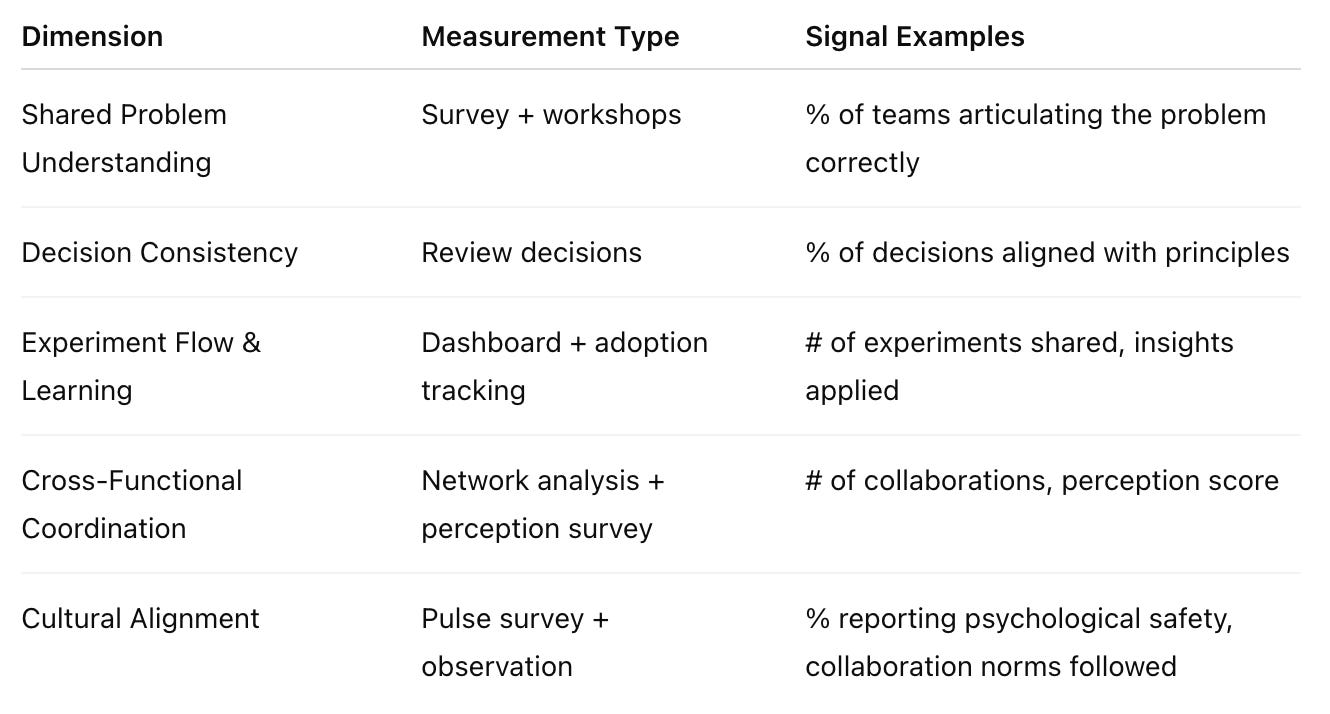
Tip: Use scores as conversation starters, not targets. The real goal is continuous reflection and adaptive behavior.
Leadership Implications
Alignment in innovation is not about control—it’s about enabling coordinated autonomy, with a bias towards entre-/intrapreneurship (high flow of actioning, testing, learning and skin in the game):
Communicate intent clearly: Share “why” and “what matters most next.”
Empower teams with principles: Let them make decisions within a framework.
Foster visibility of learning: Make insights and experiments transparent.
Connect across boundaries: Encourage collaboration beyond silos.
Iterate continuously: Revisit assumptions, priorities, and alignment measures regularly.
The leaders who master this create organizations that are nimble, coherent, and resilient, able to pursue bold initiatives without fragmentation.
Reflections
Alignment is often misunderstood because it is dynamic, multidimensional, and human. It is easy to confuse alignment with agreement or control, but true alignment is about clarity, coordination, and shared purpose.
Leaders who focus on alignment in innovation do more than issue directives. They cultivate conditions where teams can explore, learn, and adapt, while still moving in the same strategic direction. Misalignment is inevitable in complex, innovative work—but it can be surfaced, measured, and improved.
The challenge is not defining alignment in abstract terms; the challenge is embedding it into everyday decision-making, behaviours, and learning loops. That is what separates organizations that stumble from those that innovate or transform successfully.
Closing Thought
Most organizations talk about alignment. Few understand it. Fewer still know how to measure it meaningfully. But for those willing to dig deeper, alignment becomes the backbone of business innovation and transformation: the invisible architecture that lets teams move freely, learn fast, and deliver impact together.
Alignment isn’t a goal on a slide. It’s a practice, lived daily by leaders and teams alike.

PS: I want to take a moment to thank all of you, my readers, for your support and for sharing my work. Your engagement makes writing these reflections worthwhile.
Merry Christmas, and may you enjoy a wonderful time with your loved ones.
Most alignment efforts fail because no one is exposed to the consequences of misalignment.
Where in your system does misalignment actually hurt?