


AI doesn’t make leaders better.
It makes them more of what they already are.
Every leader is being amplified—your habits, your style, your focus, and your blind spots. AI doesn’t replace judgment, creativity, or courage—it exposes and accelerates them. And in the modern workplace, this is both an opportunity and a challenge.
The Illusion of Effort-Based Leadership
For decades, leadership signals often came from effort: long hours, endless meetings, thick reports, constant oversight. These signals were how organizations judged competence.
AI changes that calculus. Routine tasks—summarizing, planning, analysis, even drafting communications—can now be done faster, cheaper, and often better by machines. The patterns that once took weeks to emerge are now visible almost instantly.
Leaders who relied on the appearance of effort to signal value suddenly see that their teams are faster, clearer, and more aligned when given AI tools. It’s not a threat—it’s an opportunity. The “doing” part of leadership is shrinking. The human work—the work AI cannot replicate—is rising in value.
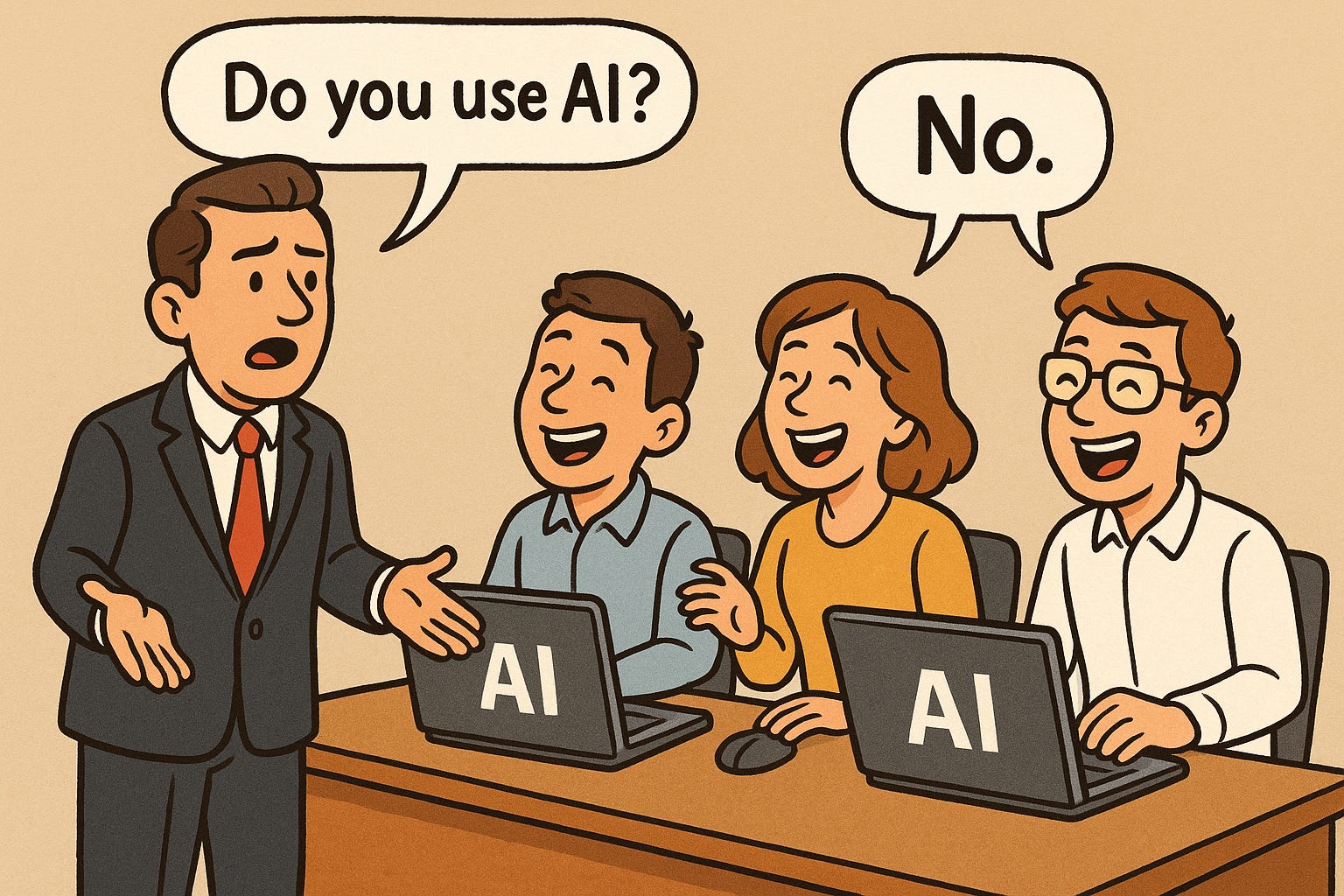
“C-suite leaders estimate that only 4 percent of employees use gen AI for at least 30 percent of their daily work, when in fact that percentage is three times greater, as self-reported by employees”.
Empowering people to unlock AI’s full potential (McKinsey, 2025)
Character Amplification: AI as a Mirror
AI doesn’t make you a better leader in the abstract. It amplifies who you already are.
If you are decisive, focused, and clear, AI accelerates your impact. If you are hesitant, indecisive, or control-oriented, AI makes those weaknesses visible.
For example: an AI tool can generate multiple strategic options for a product launch. The decisive leader evaluates quickly, chooses a path, and aligns the team efficiently. The hesitant leader stalls, over-analyzes, or second-guesses, and delays ripple through the team.
This isn’t about calling anyone out. It’s about observable outcomes. AI shows where your strengths and limitations affect your team—and does so faster than ever before.
Practical takeaways for leaders:
Use AI to accelerate reflection on your own style.
Observe how your team reacts to your decisions in AI-supported scenarios.
Treat AI output as a mirror, not a replacement, for human judgment.
Leadership as a Design Discipline
The rise of AI shifts the role of the leader from “doer” to “designer.”
Where leaders used to spend most of their time producing work themselves—writing reports, analyzing data, generating plans—they now orchestrate human + AI systems. Leadership becomes a matter of design:
Decisions: Which options to pursue, and which trade-offs matter most.
Team workflows: Aligning roles, responsibilities, and collaboration paths to leverage human creativity.
Priorities: Determining what is urgent, what is important, and what can be delegated to AI.
Experiments: Testing new approaches, learning fast, and iterating.
This shift is measurable. Teams that operate under leaders who treat leadership as design achieve faster innovation cycles and higher engagement scores. The human element—judgment, empathy, and clarity—becomes the differentiator.
Example: Consider a product manager using AI to summarize customer feedback from thousands of interactions. The AI identifies key trends, but it’s the leader who decides which signals to act on, how to communicate changes to the team, and what experiments to run next.
Courage as the Last Scarce Resource
With AI reducing the cost of analysis and execution, the true bottleneck becomes courage:
Courage to decide with incomplete data
Courage to delegate to AI and trust the team
Courage to act quickly in uncertain environments
AI accelerates outcomes for leaders willing to embrace risk and uncertainty. Those unwilling to let go of old habits—micro-managing, over-controlling, or waiting for perfect information—find that AI amplifies friction rather than efficiency.
Fact-based perspective: Research in innovation-focused organizations shows that the most successful teams are those led by managers who empower decisions and tolerate calculated risks, often supported by AI for rapid scenario modeling. (Harvard Business Review, 2024)
Practical tip: Measure courage not by bold gestures, but by frequency of timely decisions and willingness to experiment with AI as a tool for the team.
AI Is Not Human vs. Machine
It’s easy to frame AI as a competitor: human versus machine. But this framing misses the point. AI is a tool—a lever—that allows leaders to become better humans, serving other humans more effectively.
It’s human AND AI to get really funky.
AI amplifies judgment, clarity, and courage. It accelerates impact, but it does not define purpose. Leadership remains about humans, for humans. Machines are the enablers, not the actors.
Practical Steps for Innovation Leaders Today
Observe patterns in your behavior: AI can reveal delays, indecision, and focus gaps. Treat these as data, not criticism.
Design your team’s workflows: Decide what humans do best and what AI can support.
Prioritize courage: Make key decisions faster, experiment more, and iterate boldly.
Measure outcomes, not outputs: Focus on team alignment, learning, and human impact.
Reflect constantly: Ask, “How am I becoming a better human with AI as my tool?”
The Bigger Picture
AI is not a threat to human leadership. It is a lens: clearer, faster, and more revealing than ever before. Leadership is no longer about managing outputs or effort—it’s about amplifying clarity, orchestrating collaboration, and exercising courage.
Those who embrace this shift will lead teams that are not only more effective but more human. AI is the car; leadership is the journey. The purpose is not mastery of the machine—it is mastery of the human dimension, accelerated by the machine.
Closing Thought
AI will magnify what you already are.
Leaders who focus on character, intentional design, and courage will thrive.
Ask yourself: how can I get better as a human, serving other humans, using all the skills I have—including AI?
The future of leadership is human first. AI just helps you become clearer, faster, and more effective along the way.
PS: Support in innovation work with or without AI needed?
Want to push your innovation projects forward with smarter workflows and AI-assisted clarity?

Further readings:
How AI Usage Reshapes Employee Self-Efficacy and Willingness to Take Risks
The Impact of Generative Artificial Intelligence on Ideation and the performance of Innovation Teams